
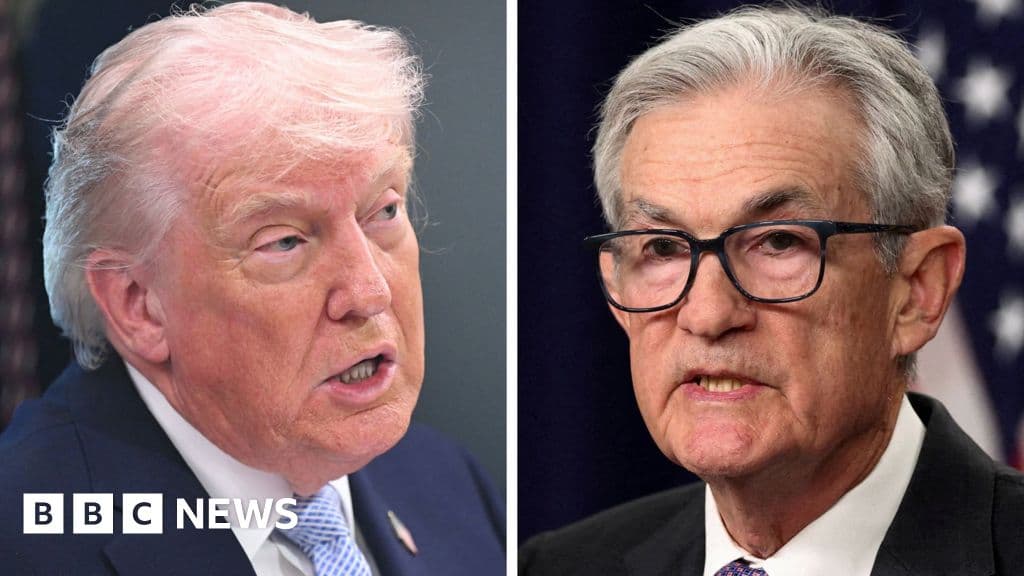
Image: BBC Business
Explore the tumultuous relationship between Trump and Powell, highlighting major clashes and their implications for the future of the Federal Reserve.
GlipzoThe relationship between former President Donald Trump and Federal Reserve chair Jerome Powell stands out as one of the most contentious interactions between a U.S. president and a central banker in recent history. Since Trump returned to the White House, he has not held back in his criticism of Powell, primarily due to the Fed's reluctance to lower interest rates as swiftly as the 45th president desires. With Powell set to step down, possibly being replaced by Trump's preferred nominee Kevin Warsh, it’s essential to reflect on the notable clashes that have characterized this fraught relationship.
Initially, when Trump nominated Powell for the role in November 2017, he touted him as the ideal candidate for the job, highlighting the need for "strong, sound, and steady leadership" at the Federal Reserve. Trump characterized Powell as "strong," "committed," and "smart." However, as time passed and interest rates failed to meet Trump’s expectations, his tone dramatically shifted. In July 2023, Trump voiced his disbelief that Powell had been appointed, stating, "He’s a terrible Fed chair. I was surprised he was appointed. I was surprised, frankly, that Biden put him in and extended him."
This irony is not lost on observers, as it was Trump himself who selected Powell for the position, a fact that underscores the volatility of their relationship.
Trump’s grievances with Powell have often been publicly expressed in colorful language. Since his return to the White House, Trump has repeatedly called for more aggressive interest rate cuts, a stance that has drawn ire from Powell and his colleagues at the Fed. Whenever the Federal Reserve opted to maintain interest rates, Trump unleashed a barrage of insults directed at Powell.
Trump’s rhetoric has been relentless, suggesting that Powell’s decisions have cost the nation “trillions of dollars” due to what he considers incompetence.
The animosity between the two men was further highlighted during a face-to-face meeting concerning the renovation of Federal Reserve buildings. Trump asserted that the costs had ballooned to $3.1 billion, while Powell maintained that the figure was closer to $2.7 billion. Their exchange became a microcosm of their broader disagreements, with Trump claiming that Powell was unaware of the expenses and Powell countering that Trump had misrepresented the situation.
This back-and-forth illustrates the tension not only in their professional relationship but also their differing approaches to fiscal responsibility and accountability.
In a shocking turn of events, Powell revealed in a January 2024 video that federal prosecutors had launched a criminal investigation into his testimony regarding the Fed's renovations. This announcement marked a pivotal moment in their relationship, with Powell asserting that the investigation was indicative of the broader pressures exerted by Trump’s administration.
Powell stated, “This is about whether the Fed will be able to continue to set interest rates based on evidence and economic conditions, or whether instead monetary policy will be directed by political pressure or intimidation.” This statement not only signaled Powell's growing frustration but also illuminated the extent to which political dynamics have intruded upon the independence of the Federal Reserve.
The ongoing conflict between Trump and Powell is emblematic of a larger trend in U.S. politics where the autonomy of central banking is increasingly challenged by political figures. The Federal Reserve's ability to make decisions free from political interference is crucial for maintaining financial stability and economic growth. Powell's tenure has been marked by significant challenges, including navigating the complexities of interest rates during tumultuous economic times.
As Trump continues to exert influence over the Republican Party and potential candidates for the Federal Reserve, the implications for future monetary policy remain uncertain. If Warsh is appointed, observers will be keenly watching how his policies align with Trump's vision and whether they will prioritize political pressures over sound economic principles.
As we look ahead, the economic landscape will be shaped by the outcome of Powell's departure and the potential appointment of Warsh. Key indicators to watch include: - Interest Rate Adjustments: How quickly will the new chair implement rate changes? - Inflation Trends: Will there be a shift in focus that impacts inflation rates? - Federal Reserve Independence: Will the new leadership maintain the Fed's autonomy against political pressures?
As events continue to unfold, one thing is clear: the relationship between the presidency and the Federal Reserve will remain a focal point for economic discussions, impacting both domestic and global markets.

Tensions soar as the US and Iran engage in air strikes near the Strait of Hormuz, raising concerns over global oil supply and regional stability.
BBC World
Trump's international interventions face serious stalemates. What will this mean for U.S. foreign policy? Explore the critical challenges ahead.
Indian Express
Tehran denies resignation of President Masoud Pezeshkian amid claims of IRGC influence. What does this mean for Iran's political stability? Click to learn more!
Indian Express