
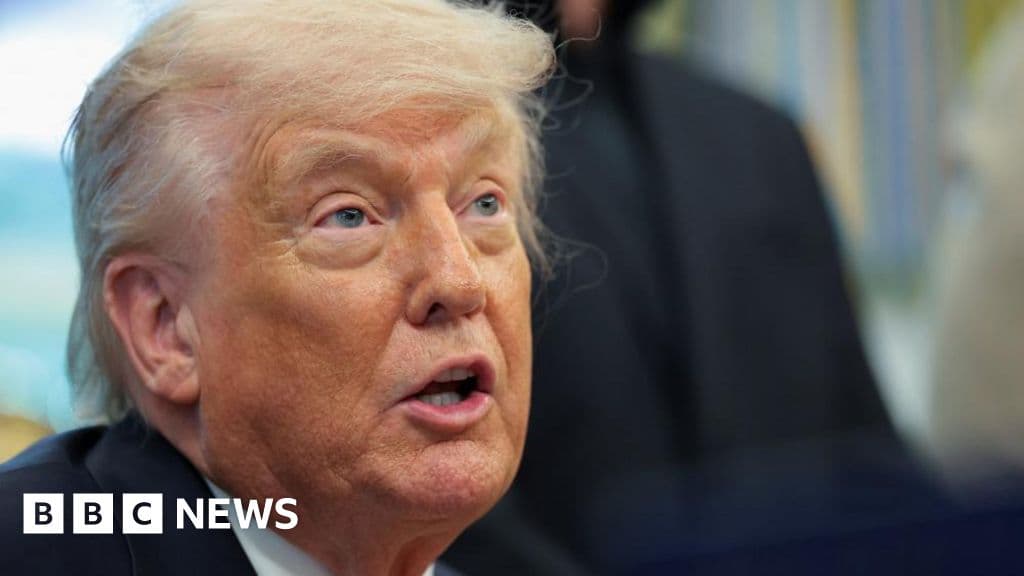
Image: BBC Business
Trump threatens the EU with higher tariffs by July 4 unless trade deal terms are met. Will negotiations succeed or stall further?
GlipzoIn a dramatic escalation of trade tensions, President Donald Trump has issued the European Union (EU) an ultimatum regarding tariffs, threatening to impose "much higher" levies by July 4 if the bloc does not eliminate its tariffs on U.S. goods. This bold move came after a phone call with European Commission President Ursula von der Leyen, marking a critical moment in U.S.-EU trade relations.
During his conversation with von der Leyen, Trump stated that he is willing to give the EU until the 250th anniversary of the United States to comply with his demands. If the EU fails to respond positively, he warned that tariffs would escalate significantly. This ultimatum adds pressure on European lawmakers and governments to expedite negotiations.
In response, von der Leyen indicated that the EU is making progress towards reducing tariffs. Her comments suggest that there may still be room for negotiation, despite Trump's assertive stance.
Hours after Trump's pronounced threat, a U.S. trade court delivered a significant ruling. The court determined that Trump's recent 10% global tariffs lack justification under U.S. trade law, opening the door for potential legal challenges in the future. This ruling adds complexity to the ongoing trade discussions and could influence the negotiations moving forward.
The contentious trade agreement was initially forged between von der Leyen and Trump in July 2022, aimed at fostering better trade relations. However, progress has been slow, particularly following talks between EU lawmakers and member states that concluded without a consensus on Wednesday. Von der Leyen emphasized both parties' commitment to implementing the deal, though tensions remain high.
Under the terms of the agreement, U.S. tariffs on EU exports would face a 15% levy, while Trump has previously threatened a 30% tariff on European goods. The European Parliament conditionally approved the deal in March, contingent upon certain safeguards to ensure the U.S. adheres to its commitments. These stipulations include the exclusion of European goods made with steel and aluminum from Trump's global tariffs on those products.
Despite the European Parliament's initial conditional approval, the trade deal requires unanimous support from all 27 EU member states. This complexity adds layers of difficulty to an already intricate negotiation process. Earlier on Thursday, Bernd Lagne, the chief negotiator for the European Parliament, expressed optimism about the ongoing discussions but acknowledged that substantial work remains.
The next round of negotiations is scheduled for May 19 in Strasbourg, where both sides hope to advance their positions and reach an agreement that satisfies their respective interests. Lagne reaffirmed the importance of ensuring guarantees that would be beneficial for citizens and companies in both the EU and the U.S.
In recent weeks, Trump has publicly accused the EU of not adhering to the terms of their agreed-upon trade deal. In a post on Truth Social, he threatened to impose tariffs of 25% on trucks and cars from Europe if compliance is not met. This rhetoric highlights the fragility of the relationship between the U.S. and the EU in regard to trade.
The backdrop of these negotiations is fraught with legal challenges for Trump, as his broader tariff initiatives have encountered significant pushback in U.S. courts. The recent ruling from the U.S. Court of International Trade indicates that Trump's 10% tariffs, introduced on February 24, might not be sustainable under current legal frameworks. The court found that the justification for these tariffs under the 1974 Trade Act was inadequate, further complicating Trump's trade strategy.
As the deadline approaches, the stakes for both the U.S. and the EU rise. The outcome of the trade negotiations will have significant implications for economic relations on both sides of the Atlantic. Observers will be keen to see how both parties navigate the legal challenges and political pressures they face.
Looking ahead, several key factors will be crucial in shaping the future of U.S.-EU trade relations: - Compliance and Negotiation: Will the EU meet Trump's demands, or will negotiations continue to stall? - Legal Challenges: How will the U.S. courts respond to ongoing tariff disputes, and what implications will this have for Trump's trade policies? - Political Ramifications: How will these trade tensions impact the broader political landscape in both regions?
As the situation evolves, all eyes will be on the upcoming negotiations and the potential for a resolution that satisfies both sides. It remains to be seen whether Trump's ultimatum will lead to a breakthrough or further complicate the already tenuous trade relationship between the U.S. and the EU.

Tensions soar as the US and Iran engage in air strikes near the Strait of Hormuz, raising concerns over global oil supply and regional stability.
BBC World
Trump's international interventions face serious stalemates. What will this mean for U.S. foreign policy? Explore the critical challenges ahead.
Indian Express
Tehran denies resignation of President Masoud Pezeshkian amid claims of IRGC influence. What does this mean for Iran's political stability? Click to learn more!
Indian Express