
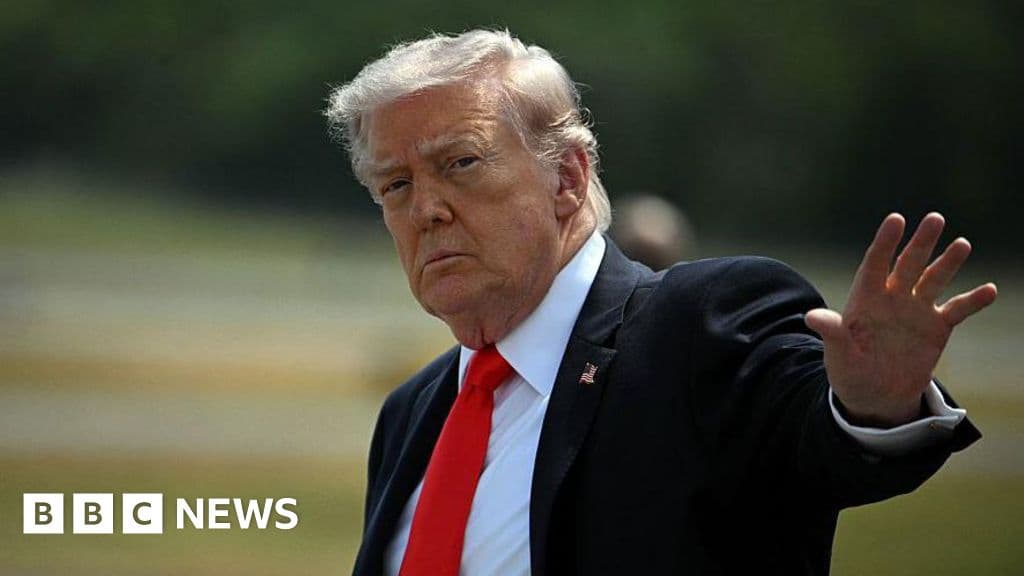
Image: BBC Business
Trump announces US will guide ships through Hormuz Strait, raising tensions with Iran amid humanitarian concerns and potential diplomatic breakthroughs.
GlipzoIn a significant announcement, President Donald Trump stated that the United States will assist in guiding stranded vessels out of the Strait of Hormuz starting Monday. This decision comes amid heightened tensions in the region and aims to ensure safe passage for ships navigating this critical waterway.
Trump emphasized the importance of this initiative, describing it as a vital step for Iran, the Middle East, and the United States. Through a post on social media, he expressed that the U.S. has communicated its intention to help various countries, although he did not specify which nations would receive this assistance. He referred to this operation as “Project Freedom,” indicating a broader humanitarian effort to support maritime navigation in the Gulf.
The President made it clear that any obstruction to this operation would be met with a forceful response. This statement adds a layer of complexity to the already fraught relationship between the U.S. and Iran, especially since the Iranian government has imposed severe restrictions on maritime traffic through this strategic strait since the onset of the war in February.
In reaction to Trump's announcement, Ebrahim Azizi, a senior Iranian lawmaker and former commander of the Islamic Revolutionary Guards Corps, warned that any American interference would be interpreted as a breach of the ceasefire. This tension underscores the precarious nature of U.S.-Iran relations, especially as the U.S. continues to enforce a naval blockade on Iranian ports.
Trump framed the operation as a humanitarian gesture, intended to alleviate the plight of sailors trapped in the Gulf. An estimated 20,000 sailors are currently stranded due to the ongoing conflict, raising alarms about their dwindling supplies and mental health. The President reiterated that the initiative aims to assist those who have committed no wrongdoing, indicating a desire to prioritize safety and stability in the region.
The U.S. Central Command has committed significant resources to this mission, involving 15,000 personnel, guided-missile destroyers, and over 100 aircraft. This extensive military presence highlights the seriousness of the operation and the commitment of the U.S. to maintaining navigational freedom in the Strait of Hormuz.
The Strait of Hormuz is a crucial maritime passage, with around 20% of the world’s oil and liquefied natural gas (LNG) typically transiting through these waters. The ongoing conflict has already led to a surge in global energy prices, further emphasizing the economic ramifications of instability in this region.
On Sunday, the United Kingdom Maritime Transportation Operation (UKMTO) reported a concerning incident wherein a tanker was struck by an unknown projectile in the strait. Fortunately, the crew was reported safe, but such incidents raise alarms about the safety of maritime operations in the area.
Trump's announcement coincided with reports from Iranian state-linked media indicating that Tehran had received a U.S. response to its latest peace proposal. Delivered via Pakistan, Iran is currently reviewing the response, although the U.S. has not formally confirmed its communication. Notably, Trump labeled the peace proposal as unacceptable, reflecting the ongoing diplomatic stalemate between the two nations.
The 14-point peace plan proposed by Iran calls for the withdrawal of U.S. forces from the region and an end to its naval blockade of Iranian ports, along with a cessation of hostilities, including Israel’s actions in Lebanon. Iranian officials have expressed a desire to finalize an agreement within 30 days, aiming to prioritize a resolution to the conflict.
In the backdrop of these developments, the Iranian foreign ministry has indicated that there are currently no nuclear negotiations taking place, a significant demand from Washington. Iran has consistently maintained that its nuclear program is for peaceful purposes, despite the ongoing scrutiny regarding its uranium enrichment activities.
As the situation progresses, there remains a palpable tension surrounding the potential for further military engagement or diplomatic breakthrough. Trump has acknowledged receipt of the Iranian peace proposal and indicated a willingness to review it, though he has expressed skepticism regarding its acceptability.
The coming days will be crucial in determining the trajectory of U.S.-Iran relations and the stability of maritime operations in the Strait of Hormuz. As Project Freedom unfolds, observers will be keenly watching for any signs of military conflict or potential diplomatic resolutions. With both sides entangled in a complex web of negotiations and military posturing, the international community remains on alert for developments in this high-stakes region.
The Strait of Hormuz is not just a strategic military point; it is a lifeline for global energy supplies. Any disruption here has far-reaching implications for economies worldwide. The U.S. involvement through Project Freedom could either pave the way for a safer navigational environment or exacerbate tensions with Iran, making it an essential focal point for international relations in the coming months.

Tensions soar as the US and Iran engage in air strikes near the Strait of Hormuz, raising concerns over global oil supply and regional stability.
BBC World
Trump's international interventions face serious stalemates. What will this mean for U.S. foreign policy? Explore the critical challenges ahead.
Indian Express
Tehran denies resignation of President Masoud Pezeshkian amid claims of IRGC influence. What does this mean for Iran's political stability? Click to learn more!
Indian Express