
Image: BBC World
Taiwan's President Lai visits Eswatini after a canceled trip due to Chinese pressure. Explore the implications of this diplomatic maneuver.
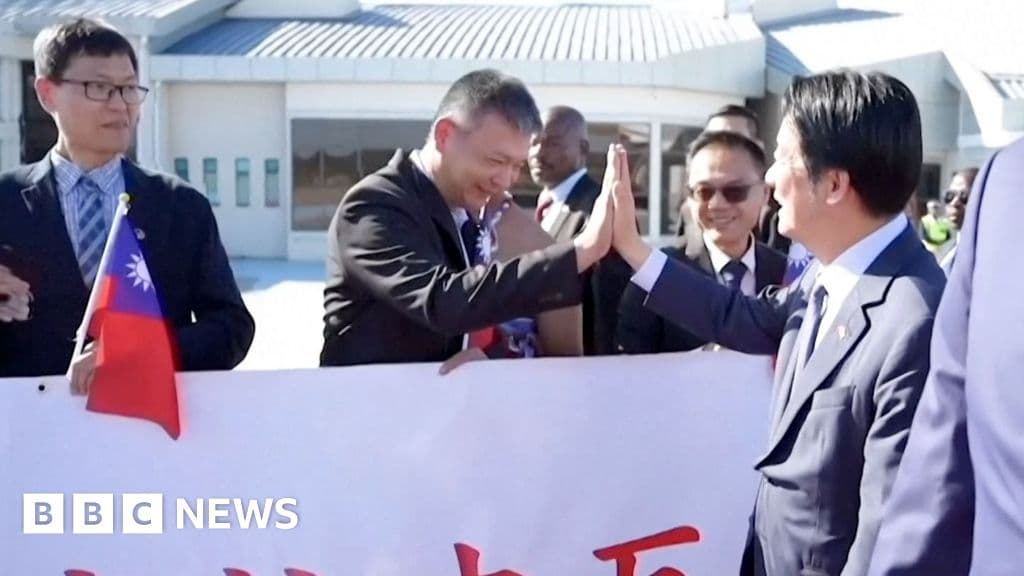
GlipzoIn a striking development for international relations, Taiwan's President Lai Ching-te has made a significant visit to Eswatini, just days after his plans to travel were thwarted by China's diplomatic pressure. This visit, which marks a rare moment of interaction between Taiwan and one of its few remaining allies in Africa, highlights the ongoing tensions surrounding Taiwan's status as an independent entity amidst China's claims over the island.
This unexpected trip comes after Taiwan's government announced that a previous visit scheduled for April 22-26 had to be canceled due to Chinese influence compelling countries such as Seychelles, Mauritius, and Madagascar to deny airspace access for Lai's flight. The cancellation served as a stark reminder of China's increasing leverage over nations in Africa, particularly regarding their diplomatic relations with Taiwan.
Upon arrival, President Lai was warmly welcomed by Eswatini Prime Minister Russell Dlamini, who greeted him with a ceremonial guard of honor. The Taiwanese delegation included notable figures such as Foreign Minister Lin Chia-lung and National Security Council Adviser Alex Huang. However, the visit was characterized by its discreet nature, with neither government announcing it in advance.
Lai expressed gratitude for Eswatini’s steadfast support, emphasizing the importance of their diplomatic relationship. He stated, "Taiwan will never be deterred by external pressures. Our resolve & commitment are underpinned by the understanding that Taiwan will continue to engage with the world - no matter the challenges faced."
Lai's visit is particularly significant as Eswatini is one of just 12 countries globally that maintain formal diplomatic relations with Taiwan. This highlights Taiwan's ongoing struggle to maintain its international presence in the face of increasing pressure from China, which considers Taiwan a breakaway province with no right to sovereignty.
In the wake of Lai's visit, China responded harshly, with its foreign ministry labeling the trip a “stowaway-style escape farce.” They reiterated their stance that Taiwan is an inseparable part of China's territory, dismissing any efforts from the Taiwanese government to strengthen its international relations as futile. Beijing's rhetoric serves to underscore its commitment to isolating Taiwan diplomatically.
China’s foreign ministry also advised Eswatini to reconsider its alliance with Taiwan, describing it as aligning with a movement for “Taiwan independence” that would ultimately be detrimental. They have also taken actions against Eswatini by scrapping tariffs for all African nations, except for Eswatini, as a further demonstration of their disapproval.
During his time in Eswatini, Lai is expected to engage in bilateral talks with King Mswati III, which will include discussions aimed at enhancing cooperation in various sectors such as economics, agriculture, culture, and education. The Taiwanese president expressed hopes that this visit would deepen the friendship between the two nations, helping to fortify Taiwan's international standing.
Lai's diplomatic efforts come at a time when Taiwan is seeking to reinforce its remaining partnerships abroad. The Taipei government continuously emphasizes the necessity of maintaining relationships with its few diplomatic allies, as these ties become increasingly valuable in the face of Chinese aggression.
The significance of Lai's visit extends beyond Taiwan and Eswatini. It serves as a crucial indicator of the shifting geopolitical landscape in Africa, where Chinese influence is growing while Taiwan's diplomatic presence is under threat. The visit illustrates Taiwan's commitment to seeking allies and building partnerships despite external pressures, which could inspire other nations to reassess their stances on Taiwan.
As Taiwan continues to navigate the complex waters of international politics, observers should monitor: - Future diplomatic engagements between Taiwan and its allies, particularly in Africa. - Responses from other African nations regarding their relationships with Taiwan amidst Chinese pressures. - China’s continued efforts to isolate Taiwan diplomatically and the effectiveness of these strategies.
Lai's visit to Eswatini marks a bold assertion of Taiwan’s sovereignty and commitment to maintaining its international partnerships, setting the stage for potential shifts in diplomatic relations within the region and beyond.

Tensions soar as the US and Iran engage in air strikes near the Strait of Hormuz, raising concerns over global oil supply and regional stability.
BBC World
Trump's international interventions face serious stalemates. What will this mean for U.S. foreign policy? Explore the critical challenges ahead.
Indian Express
Tehran denies resignation of President Masoud Pezeshkian amid claims of IRGC influence. What does this mean for Iran's political stability? Click to learn more!
Indian Express