
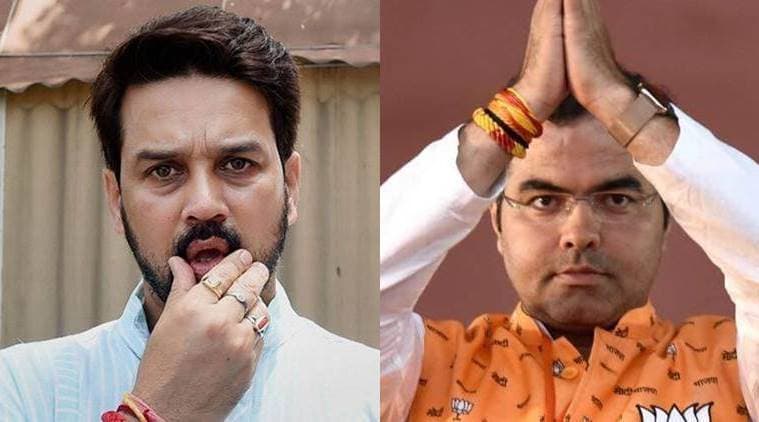
Image: Indian Express
Supreme Court clears Delhi Deputy CM Parvesh Verma in a pivotal ruling on hate speech accusations, reinforcing legal standards for FIR registration.
GlipzoIn a significant ruling, the Supreme Court of India has cleared Delhi Deputy Chief Minister Parvesh Verma and BJP leader Anurag Thakur of allegations related to hate speech made during the protests against the Citizenship (Amendment) Act in January 2020. The verdict came on Wednesday, affirming the findings of the Delhi High Court, which had previously determined that the statements made by the two leaders did not incite violence or disrupt public order. This decision has far-reaching implications regarding hate speech laws and the responsibilities of public officials in India.
The case arose from a petition filed by Communist Party of India (Marxist) leaders Brinda Karat and K. M. Tiwari, who contended that the remarks made by Verma and Thakur were inflammatory. However, the Supreme Court's bench comprising Justices Vikram Nath and Sandeep Mehta upheld the lower court's conclusions, stating that “no cognizable offence is made out” based on the evidence presented.
The controversy began on August 26, 2020, when a trial court dismissed the complaints against Verma and Thakur, arguing that the case was not legally maintainable without prior sanction from the appropriate authority to prosecute. Subsequently, on June 13, 2022, the Delhi High Court supported this dismissal, reinforcing that the statements from the BJP leaders were not aimed at inciting violence against any specific community.
The High Court's ruling was grounded in the interpretation of Section 196 of the Code of Criminal Procedure (CrPC), which requires specific permissions before certain types of prosecutions can proceed. This provision is intended to protect public figures from frivolous or vexatious legal actions, thus ensuring that only serious and substantiated claims are allowed to move forward.
In its recent judgment, the Supreme Court diverged from the previous rulings, arguing that the requirement for prior sanction only comes into play when a magistrate is considering whether to take cognizance of the case. This distinction is critical for understanding the procedural aspects of criminal law in India. The court emphasized that the legal framework does not impose limitations on filing an First Information Report (FIR) or conducting an investigation prior to this stage.
The justices stated that, “To hold otherwise would amount to introducing a restriction not envisaged by the legislature.” They clarified that the criminal justice process is sequential and must begin with the registration of an FIR, which is mandatory when there is information suggesting that a cognizable offence has occurred.
The Supreme Court's ruling not only exonerates Verma and Thakur but also reinforces the principle that law enforcement agencies must act without undue delay in such circumstances. The court highlighted that any failure to initiate an investigation when a cognizable offence is disclosed undermines the rule of law and erodes public trust in the justice system.
Key points from the Supreme Court's ruling include: - Mandatory Registration of FIR: When information indicates a cognizable offence, the police are obligated to register an FIR without discretion. - Protection of Rights: The criminal law framework is designed to protect both accused individuals and societal interests. - Importance of Investigation: Delaying or evading statutory obligations can leave ordinary citizens vulnerable to institutional inaction.
This ruling has significant implications for how hate speech and public discourse are managed in India. It sets a precedent that may influence future cases involving public figures and their statements, particularly in a politically charged environment. Moreover, it raises essential questions about the balance between protecting free speech and ensuring public order.
As India navigates through complex social and political issues, the Supreme Court's decision highlights the ongoing tensions between legal frameworks and the actions of political leaders. It also stresses the need for clarity in laws surrounding hate speech, which remains a contentious issue in the country.
Looking ahead, this decision may prompt discussions on potential reforms in the laws pertaining to hate speech and public incitement. Observers will be keen to see if this ruling influences how authorities handle similar complaints in the future. The implications of this judgment may also resonate beyond the courtroom, affecting political rhetoric and public sentiment as India approaches future elections.
With the legal landscape evolving, it will be crucial to monitor how political leaders navigate their responsibilities in a diverse society and how the judiciary responds to emerging challenges in maintaining order and justice. The Supreme Court's ruling serves as a reminder of the delicate balance of power between the state, public figures, and the citizenry in a democratic framework.

Tensions soar as the US and Iran engage in air strikes near the Strait of Hormuz, raising concerns over global oil supply and regional stability.
BBC World
Trump's international interventions face serious stalemates. What will this mean for U.S. foreign policy? Explore the critical challenges ahead.
Indian Express
Tehran denies resignation of President Masoud Pezeshkian amid claims of IRGC influence. What does this mean for Iran's political stability? Click to learn more!
Indian Express