
Image: BBC World
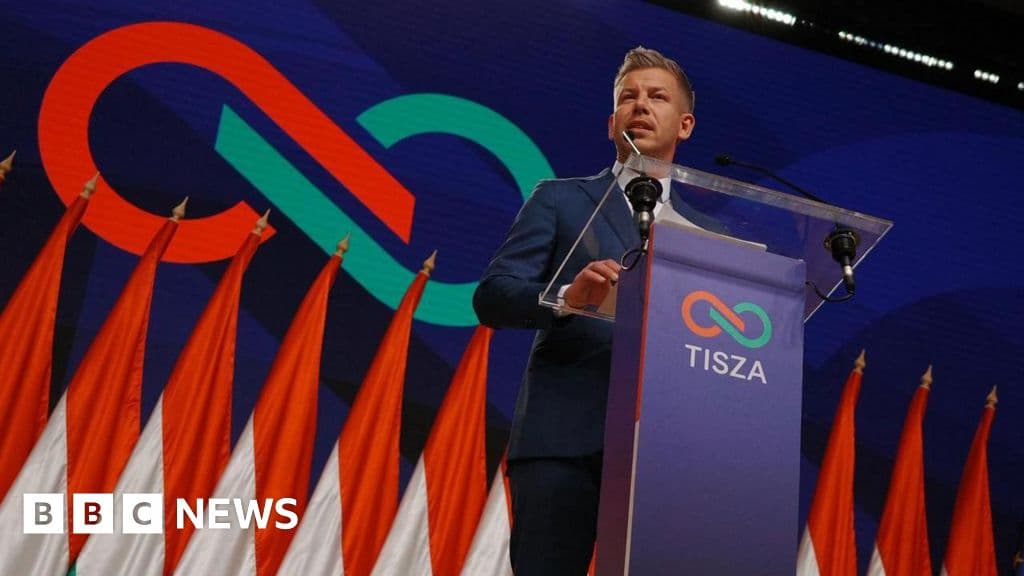
Péter Magyar's election signals a major shift in Hungary's politics, hinting at new foreign policies and a commitment to Europe. What’s next for Hungary?
GlipzoIn a stunning political turn, Péter Magyar has emerged victorious in Hungary’s recent elections, marking the end of Viktor Orbán's 16-year tenure. This shift has sent ripples across Europe, with Magyar asserting his willingness to engage in dialogue with Russian President Vladimir Putin should the opportunity arise. During a press conference following his election win, he stated, "If Vladimir Putin calls, I'll pick up the phone." This statement, while seemingly casual, underscores the potential for a significant shift in Hungary's foreign policy.
Magyar emphasized that he would urge Putin to bring an end to the ongoing conflict in Ukraine, saying, "I’d tell him to please, after four years, put an end to the killing and end this war." His willingness to engage with Putin contrasts sharply with Orbán's increasingly isolationist and pro-Russian stance, which has drawn criticism from the European Union and neighboring countries.
The Hungarian electorate has spoken decisively, granting Magyar’s Tisza Party a supermajority in parliament with 136 seats, paving the way for substantial legislative changes. With an impressive two-thirds majority, Magyar's government is positioned to initiate constitutional amendments, a move that could reshape Hungary's political landscape for years to come. The new Prime Minister remarked, "Hungarian voters have not voted just for a change of government but for complete regime change."
In this transformative moment, Magyar has already reached out to multiple European leaders, including Ursula von der Leyen, President of the European Commission. He reiterated Hungary's commitment to the European Union, stating, "Hungary has chosen Europe." This marks a notable shift from Orbán's administration, which often criticized the EU and sought to distance Hungary from European alliances.
Magyar, a former member of Orbán’s own Fidesz party, is known for his grassroots initiatives aimed at combating corruption and cronyism within the government. His approach resonates with many Hungarians who are eager for change and transparency in governance. As he prepares for his first diplomatic missions to countries like Poland, Austria, and Germany, he aims to strengthen Hungary's ties within Europe, focusing on economic cooperation and political solidarity.
In a clear indication of his priorities, Magyar has expressed a desire for Hungary to join the Eurozone, signaling a shift towards deeper economic integration with the EU. This move could potentially bolster Hungary's economy and enhance its standing within the union.
The implications of Magyar's election extend beyond Hungary’s borders. His willingness to communicate with Putin, albeit cautiously, suggests a potential for altered relations between Hungary and Russia. While he acknowledges the complexities of the Ukraine conflict, he emphasizes the need for peace, stating that the war has inflicted pain on both Ukrainian and Russian families.
This perspective marks a stark contrast to Orbán's administration, which often framed Ukraine's government as a provocateur in the conflict. Magyar’s approach could help rebuild Hungary's image in the EU, which has suffered due to Orbán's controversial foreign policy decisions, including his previous veto of a €90 billion EU aid package to Ukraine.
Magyar's foreign policy stance is not just limited to Russia. He has made it clear that he would also welcome a dialogue with former U.S. President Donald Trump if Trump were to reach out. Expressing a sentiment of camaraderie, he stated, "I’d invite him to attend the 70th anniversary of the Hungarian uprising against Soviet occupation next October." This reflects Magyar's intent to maintain strong ties with NATO allies while also navigating Hungary's relationship with Russia.
As Hungary transitions to a new government, the political dynamics in Central Europe may shift significantly. The new Prime Minister’s focus on restoring Hungary’s reputation in the EU, combined with his willingness to engage with leaders like Putin, sets the stage for a complex balancing act between East and West.
Magyar's rise to power could represent a pivotal moment for Hungary and the region. His approach to foreign relations, particularly with Russia, could influence not only Hungary's position in the EU but also the broader geopolitical landscape in Europe. With tensions in Ukraine ongoing and the EU grappling with its own internal challenges, Hungary's new leadership may play a crucial role in shaping future strategies and alliances.
Looking ahead, all eyes will be on how Magyar navigates his first months in office. Key areas to watch include: - Diplomatic Engagements: How he will manage relations with both EU leaders and Russia. - Domestic Policy Changes: Implementing anti-corruption measures and constitutional amendments. - Economic Strategies: Moves towards joining the Eurozone and stimulating economic growth.
As Hungary embarks on this new chapter under Péter Magyar, the outcomes of his policies could have lasting implications for the nation and its standing in Europe. The world will be watching closely to see how this new leadership tackles the challenges ahead.

Tensions soar as the US and Iran engage in air strikes near the Strait of Hormuz, raising concerns over global oil supply and regional stability.
BBC World
Trump's international interventions face serious stalemates. What will this mean for U.S. foreign policy? Explore the critical challenges ahead.
Indian Express
Tehran denies resignation of President Masoud Pezeshkian amid claims of IRGC influence. What does this mean for Iran's political stability? Click to learn more!
Indian Express