
Image: BBC World
An Israeli academic's shocking police encounter over a kippah with Palestinian and Israeli flags raises critical questions about freedom of expression.
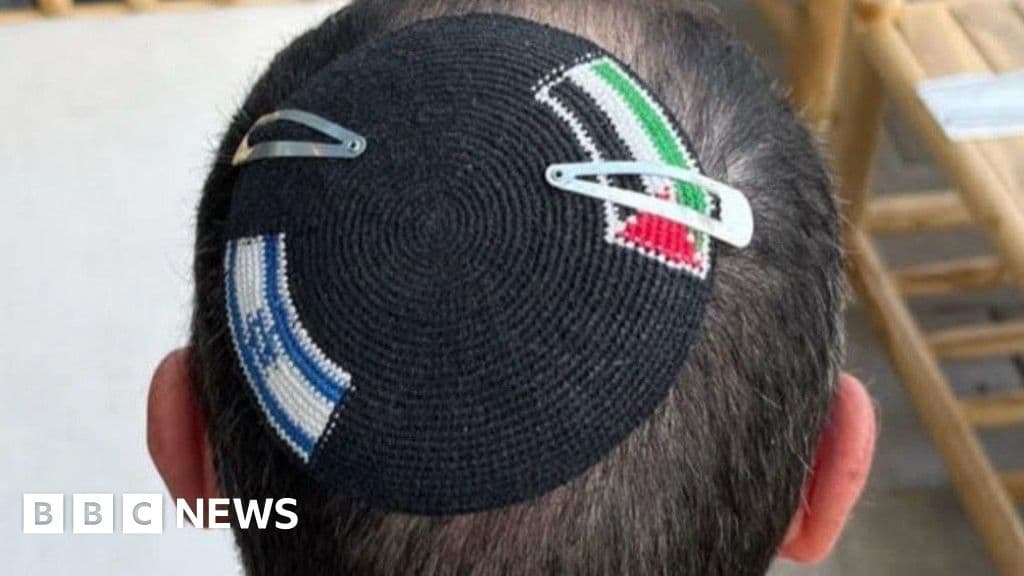
GlipzoIn a striking incident that has drawn both national and international outrage, Alex Sinclair, a 53-year-old British Israeli academic, experienced an alarming encounter with Israeli police in Modiin, central Israel, on Monday. Sinclair was detained for wearing a kippah—a traditional Jewish head covering—embellished with both the Israeli and Palestinian flags. His experience raises questions about the freedom of expression in a country marked by ongoing tensions.
Sitting in a café while working on his laptop, Sinclair was approached by a man who expressed anger over his choice of headwear. The man allegedly shouted at Sinclair, declaring, "Your kippah is against the law," prompting Sinclair to invite him for a discussion. Instead, the man opted to call the police, setting off a series of events that would lead to Sinclair's detention.
Shortly after the call, two police officers arrived at the café and informed Sinclair that his kippah was illegal. Despite his attempts to explain that wearing such a kippah was not against the law, Sinclair was taken into custody. According to his account, he was driven to a police station, where he was stripped of his personal belongings and locked in a cell. Sinclair described the experience as surreal, stating, "I was taken into detention and driven by police car to the police station. I was forced to hand over my possessions and unable to make a phone call."
After approximately twenty minutes, Sinclair was released but without his kippah. When he insisted on its return, he was handed the item back with the Palestinian flag cut off. This act has sparked outrage and led Sinclair to share his experience on social media, where it quickly gained traction.
Sinclair's choice of a kippah featuring both flags was intentional. He had worn this symbolic head covering for the past 20 years, indicating his complex identity as a Jewish-Zionist who advocates for coexistence between Israelis and Palestinians. He remarked, "I'm doing all of this as a Zionist, as somebody who chooses to live here... I've not given up on a future where we can live together in peace and security."
He explained that the design was meant to differentiate himself from the more right-wing and far-right religious nationalists in Israel. Sinclair expressed, "When you walk around Israel and people see you in a kippah, they immediately associate you with certain political and religious groups who I don't want to be associated with, to put it mildly."
The controversy surrounding Sinclair's kippah highlights the nuanced legal framework regarding the display of the Palestinian flag in Israel. While there is no explicit law prohibiting public displays of the flag, Israeli police have the authority to confiscate items they deem a threat to public order or linked to terrorist organizations. This has become particularly contentious under the direction of Itamar Ben-Gvir, the current far-right National Security Minister, who has advocated for stricter enforcement against Palestinian symbols.
In response to the uproar from Sinclair's case, Israeli police confirmed that an internal investigation has been initiated. They stated that officers were responding to a report concerning the kippah and that further details would be withheld due to the ongoing inquiry.
The incident has raised broader questions about the state of civil liberties and freedom of expression in Israel, particularly for those who advocate for the rights of Palestinians. Sinclair's story serves as a poignant reminder of the complexities surrounding identity, nationalism, and the fight for coexistence in a region fraught with conflict.
His experience resonates with many who feel that symbols of peace and shared identity are increasingly under threat. The emotional impact of the cut kippah has sparked discussions about human rights and the need for dialogue amid rising tensions.
As the investigation unfolds, it will be crucial to monitor the responses from both the Israeli government and international communities regarding freedom of expression, especially in relation to symbols that people use to represent their identities. Sinclair's case may instigate broader discussions about the rights of individuals to express their beliefs in public, particularly in a politically charged environment.
This incident also serves as a litmus test for how Israel balances national security concerns with civil liberties. As debates over identity and coexistence continue, Sinclair's experience may inspire others to engage in meaningful discussions about peace and mutual respect in a divided society.
Sinclair remains hopeful for a future where his identity as a Jewish-Zionist can coexist with his support for Palestinian rights, stating, "The journey behind it was just trying to figure out a way to keep a kippah on my head. How do I take part in a Jewish ritual that is meaningful to me but do so in a way that feels authentic?"

Tensions soar as the US and Iran engage in air strikes near the Strait of Hormuz, raising concerns over global oil supply and regional stability.
BBC World
Trump's international interventions face serious stalemates. What will this mean for U.S. foreign policy? Explore the critical challenges ahead.
Indian Express
Tehran denies resignation of President Masoud Pezeshkian amid claims of IRGC influence. What does this mean for Iran's political stability? Click to learn more!
Indian Express