
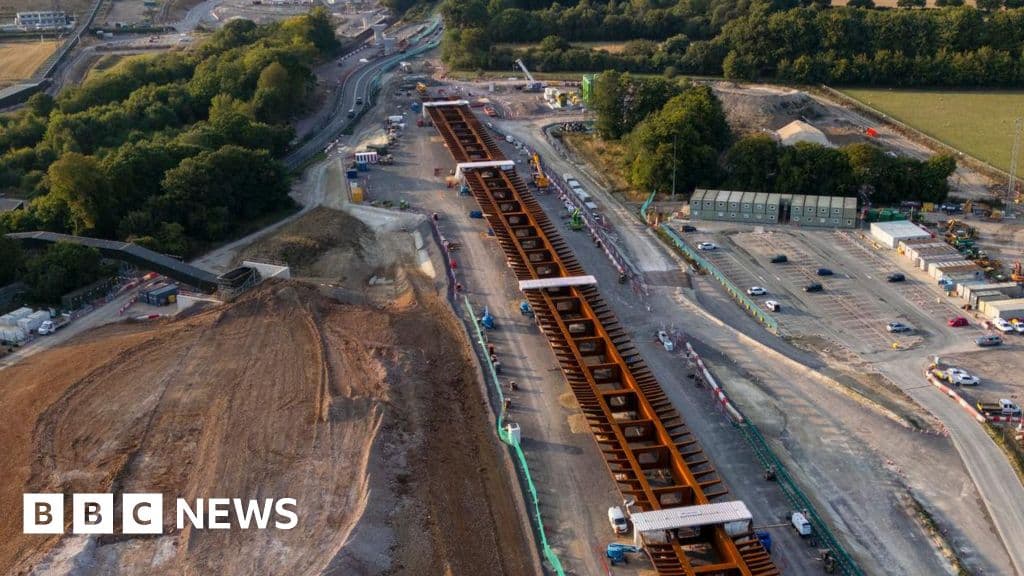
Image: BBC Business
The future of HS2 hangs in balance as costs soar. Could a full line still be built despite recent setbacks? Discover the implications for the UK economy.
GlipzoThe future of the HS2 railway project hangs precariously at a crossroads, presenting two stark choices for the UK government. As of now, the project’s fate remains uncertain, with a potential full cancellation on one side and a drastically scaled-back version connecting West London to Birmingham by the late 2030s on the other. Each option carries significant financial implications, as the costs of stopping the project are estimated to align closely with the expenses needed to complete it — around £60 billion each, bringing the total expenditure to an eye-watering £100 billion for what has become the world's most expensive railway.
HS2's original vision was ambitious: a Y-shaped line stretching from London to Birmingham, with branches extending to Manchester and Leeds. This design was not merely about speed; it aimed to enhance capacity and strategically bolster the UK economy by connecting key regions. The hope was that increased connectivity would drive investment and stimulate growth in areas outside of London, helping to address the economic imbalance that has long plagued the nation.
However, recent developments have put a cloud over this vision. After the cancellation of the Leeds and Manchester extensions, a senior official from the Department for Transport (DfT) remarked that the initial strategic rationale for HS2 — to provide transformational benefits and rebalance the economy — has effectively evaporated. What remains is a line that, while still marketed as beneficial for northern England, will terminate at Birmingham, with lingering costs and delays affecting its overall effectiveness.
The current trajectory suggests a worrying trend: HS2 is set to become a slower, less efficient service. Trains designed for HS2’s straight paths will struggle on the West Coast Main Line (WCML), where they will be limited to a maximum speed of 110 mph, significantly slower than the existing Avanti Pendolino trains that can reach 125 mph. This is particularly concerning given that the WCML is one of the busiest mixed-use railways in Europe, already operating at maximum capacity with up to 15 trains per hour.
Oddly enough, the setbacks faced by HS2 might paradoxically pave the way for the completion of the full line to Manchester Airport. The UK government remains committed to the Northern Powerhouse Rail, which utilizes HS2’s existing legal framework and route in central Manchester. After funding has been allocated for the London-Birmingham and Cheshire to Manchester segments, extending the line further may yield significant benefits at a lower cost.
Key factors supporting this potential development include: - Lower land acquisition costs compared to the original HS2 plans. - Reduced infrastructure requirements, eliminating the need for extensive tunnels and viaducts that characterized the Buckinghamshire sections of HS2. - A growing necessity to enhance rail connectivity in the UK, especially as countries like Japan, Spain, Morocco, and Uzbekistan successfully develop high-speed rail systems more efficiently and affordably.
The ongoing challenges with HS2 have illuminated critical lessons regarding project management and infrastructure development. The UK government is now faced with the imperative to refine its approach, ensuring that future projects are not only ambitious but also realistic in terms of execution and budgeting. The overspecification and rapid distribution of contracts that characterized HS2 have been scrutinized, signaling a need for reform.
As the debate around HS2 continues, it's clear that the stakes are high. The government's decisions will have lasting effects on the UK's transport infrastructure and its economic landscape. The urgency to adapt and innovate has never been greater, as the nation watches how HS2's fate might reshape the future of rail travel in Britain.
Looking forward, the next steps for HS2 will be critical in determining its viability and potential success. Observers should keep a close eye on: - The government's forthcoming announcements regarding the project’s future and any potential revisions to its scope. - Developments related to Northern Powerhouse Rail, as these could signal a shift in strategy regarding regional connectivity. - How lessons learned from HS2's challenges will influence future infrastructure projects in the UK.
In conclusion, while HS2 faces a pivotal moment, the decisions made now could lead to a reimagined vision that better serves the diverse needs of the UK economy. The potential for the full line to be built remains, but it requires careful planning, innovative thinking, and a commitment to achieving connectivity that benefits all regions of the country.

Tensions soar as the US and Iran engage in air strikes near the Strait of Hormuz, raising concerns over global oil supply and regional stability.
BBC World
Trump's international interventions face serious stalemates. What will this mean for U.S. foreign policy? Explore the critical challenges ahead.
Indian Express
Tehran denies resignation of President Masoud Pezeshkian amid claims of IRGC influence. What does this mean for Iran's political stability? Click to learn more!
Indian Express