
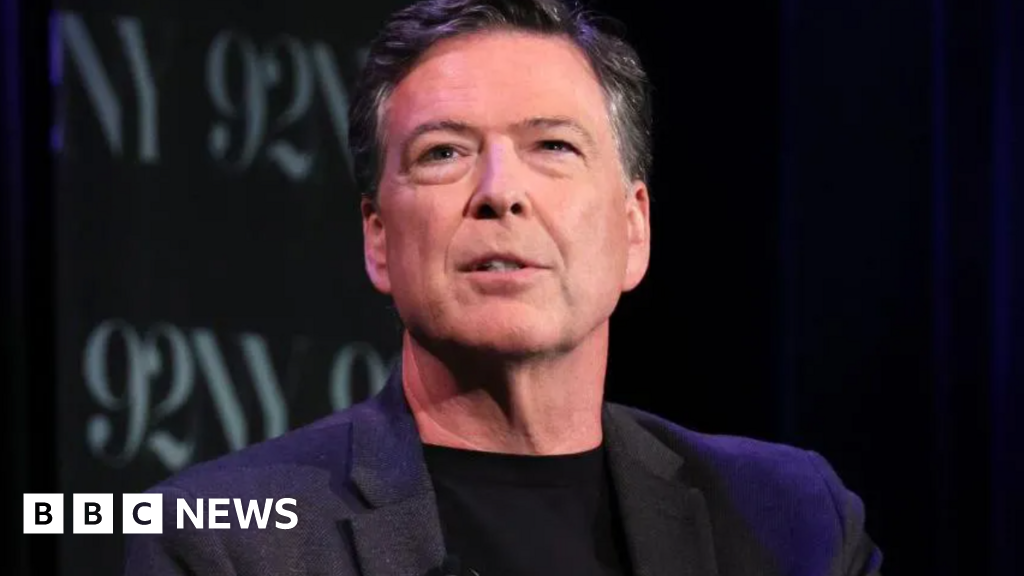
Image: BBC World
James Comey faces serious charges for threatening Trump on Instagram. Discover the details behind this shocking indictment and its implications.
GlipzoIn a stunning turn of events, James Comey, the former FBI Director, has been charged with threatening the life of former President Donald Trump. This unprecedented accusation arises from an Instagram post that Comey shared briefly last year, featuring an image of seashells that formed the numbers "86 47".
The term "eighty-six" is commonly understood in slang as a call to eject or remove someone. While Comey maintains that he was unaware of the connotation behind the numbers, Trump and officials from his administration have labeled the post as a blatant threat against the 47th President of the United States.
In a statement addressing the charges, Comey reiterated his innocence, stating: "I'm still innocent, I'm still not afraid, and I still believe in the independent federal judiciary."
During a press conference announcing the indictment, FBI Director Kash Patel emphasized Comey's past role at the agency, asserting that he should have understood the implications of such a post. Patel remarked, "James Comey disgracefully encouraged a threat on President Trump's life and posted it on Instagram for the world to see."
The tensions between Comey and Trump have been longstanding, especially since Comey was dismissed by Trump in 2017 after instigating an investigation into Russian interference in the 2016 presidential election. This recent indictment marks the second attempt by the Trump administration to prosecute Comey, following a series of calls from Trump for legal action against his former FBI director.
Comey has been charged with two offenses: making a threat against the President and transmitting a threat in interstate commerce. Each charge holds a maximum penalty of 10 years in prison. Acting Attorney General Todd Blanche stated, "Threatening the life of the President of the United States is a grave violation of our nation's laws," highlighting the seriousness of the allegations.
In May, Comey was interviewed by U.S. Secret Service agents regarding the seashell photo, which he later deleted. He expressed regret, claiming he did not realize the numbers could be interpreted as violent. "I didn't realize some folks associate those numbers with violence. It never occurred to me but I oppose violence of any kind so I took the post down," he explained.
Trump, who has frequently criticized Comey, reacted to the Instagram post by stating, "a child knows what that meant." This comment underscores the polarized perceptions surrounding Comey's actions. Legal experts have scrutinized the indictment, with some labeling it as insubstantial and indicative of the Department of Justice’s (DOJ) efforts to target Trump’s political adversaries.
Michael Gerhardt, a constitutional law expert at the UNC School of Law, commented, "It's very thin," suggesting that the case might struggle in court. He further noted that Comey’s social media post could be viewed as protected free speech under the First Amendment.
Former federal prosecutor Jimmy Gurulé echoed these sentiments, stating, "The DOJ will not be able to prove beyond a reasonable doubt that James Comey had the intent to threaten or harm President Trump." Gurulé characterized the indictment as an embarrassment to the American criminal justice system, arguing that it appears to be a transparent attempt to intimidate a political opponent.
This is not the first time Comey has faced legal challenges. In September, he was indicted by a federal grand jury for allegedly lying to Congress and obstructing a congressional proceeding during his testimony in September 2020. The charges were filed shortly after Trump pressed for a more aggressive investigation into Comey and other political adversaries.
Comey pleaded not guilty to those charges in October, but the case was dismissed by U.S. District Judge Cameron Currie in November due to the prosecutor's "invalid" appointment. This history adds layers to the current situation, reflecting the ongoing tensions between Comey and Trump.
As legal proceedings unfold, the implications of this case extend beyond Comey himself. It raises critical questions about the boundaries of free speech, the politicization of the justice system, and the lengths to which political figures will go to silence dissent.
Observers will be keenly watching how the DOJ navigates this case and whether Comey’s previous legal battles will influence the outcome. Additionally, the potential backlash from this indictment could further polarize political sentiments in the country.
In conclusion, as the story develops, it will be essential to monitor the legal arguments presented and how they resonate within the broader political landscape. The intersection of law, politics, and social media has never been more pronounced, and the ramifications of this case could be significant for both Comey and the Trump administration.

Tensions soar as the US and Iran engage in air strikes near the Strait of Hormuz, raising concerns over global oil supply and regional stability.
BBC World
Trump's international interventions face serious stalemates. What will this mean for U.S. foreign policy? Explore the critical challenges ahead.
Indian Express
Tehran denies resignation of President Masoud Pezeshkian amid claims of IRGC influence. What does this mean for Iran's political stability? Click to learn more!
Indian Express