
Image: BBC World
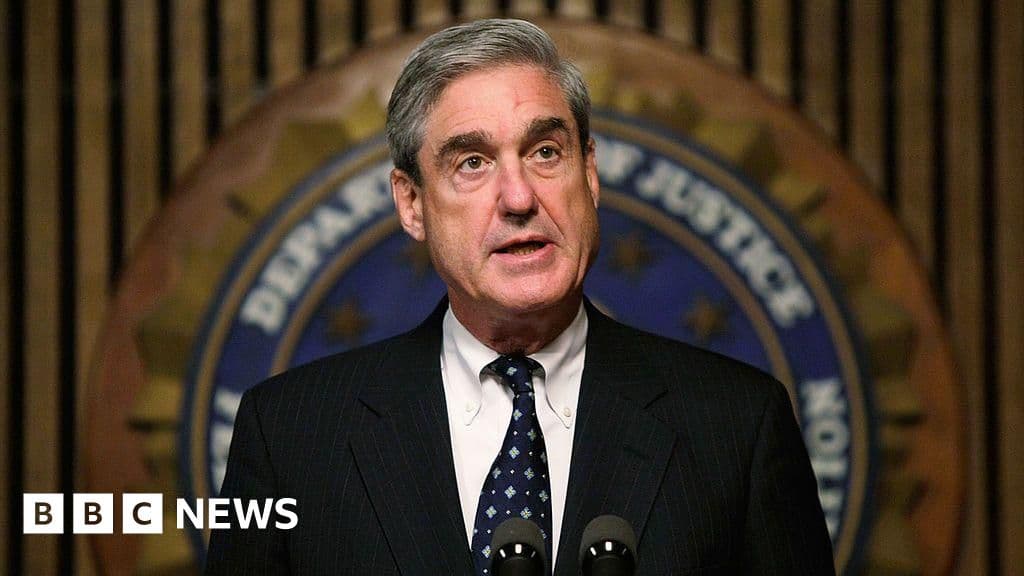
Robert Mueller, the ex-FBI chief who led the Trump-Russia investigation, has died at 81. Learn about his legacy and the impact of his work.
GlipzoRobert Mueller, the distinguished former special counsel known for leading the investigation into alleged Russian interference in the 2016 U.S. presidential election, has passed away at the age of 81. His family confirmed his death on Friday night, expressing their deep sorrow and requesting privacy during this difficult time. The cause of his passing has yet to be disclosed, as reported by CBS News and other media outlets.
Mueller's career spanned several decades, including a significant tenure as the 6th Director of the FBI, from 2001 to 2013. He took the helm of the Bureau just days before the tragic September 11 attacks, a pivotal moment that reshaped his leadership approach toward counterterrorism, marking a transformation of the FBI into a more robust national security agency.
Survived by his wife, Ann Cabell Standish, their two daughters, and three grandchildren, Mueller's personal life was as noteworthy as his professional accomplishments. He was married to Standish for nearly 60 years, highlighting a commitment that paralleled his dedication to public service.
As special counsel, Mueller's investigation into the Trump campaign's ties to Russia became a defining aspect of Donald Trump's first term, drawing sharp rebukes from the president himself. Following Mueller's passing, Trump took to Truth Social to express his controversial sentiments, stating, "I'm glad he's dead. He can no longer hurt innocent people!" This statement underscores the contentious nature of Mueller's legacy.
In the wake of Mueller's death, numerous tributes have poured in from various quarters, honoring his decades of service. George W. Bush, who appointed him as FBI director, expressed his profound sadness, citing Mueller's pivotal role in transitioning the agency's mission post-9/11. Bush remarked, "He led the agency effectively, helping prevent another terrorist attack on U.S. soil."
Barack Obama also paid tribute, calling Mueller one of the finest directors in the FBI's history, commending his steadfast commitment to the rule of law. This bipartisan respect highlights the significant impact Mueller had on the nation.
Former FBI director James Comey, who succeeded Mueller, expressed his gratitude, stating, "A great American died today, one I was lucky enough to learn from and stand beside." Meanwhile, a representative from Mueller's former law firm, WilmerHale, described him as an extraordinary leader and a person of great integrity.
Born in 1944, Mueller's life journey began at Princeton University, where he studied politics. His service in the U.S. Marines during the Vietnam War was marked by commendations, including the Bronze Star and a Purple Heart for his bravery in combat. After returning from Vietnam, he pursued a law degree at the University of Virginia, graduating in 1973.
His unanimous confirmation as FBI director in August 2001 marked the beginning of a new chapter, where he oversaw crucial developments in national security and crime investigation. After retiring in 2013, Mueller would return to the spotlight in 2017 when he was appointed as special counsel to investigate Russian interference in the election.
Mueller's investigation, which spanned from May 2017 to March 2019, scrutinized not only Russia's meddling but also the potential connections to Trump's campaign. The inquiry generated unprecedented media attention, and each new finding was dissected for its implications, often leading to fierce political debates.
Trump labeled the investigation a "witch hunt," vehemently denying any collusion. The atmosphere surrounding the inquiry was charged, with Mueller himself maintaining a low profile, rarely commenting publicly on the proceedings. Andrew Weissmann, a member of Mueller's team, emphasized the integrity Mueller displayed throughout the investigation, stating, "I think it's really important for people to know how much integrity he had."
Mueller's passing marks the end of an era characterized by heightened political polarization and intense scrutiny of the executive branch. His work not only shaped public discourse around the presidency but also influenced the future of investigative practices within the FBI and beyond.
As we reflect on Mueller's life and career, it's essential to consider the implications of his work on American politics and governance. His investigation into the Trump campaign's ties to Russia will continue to resonate as a pivotal moment in U.S. history, raising questions about election integrity and foreign interference.
In the coming months, discussions surrounding Mueller's legacy will likely intensify, especially as political analysts and historians evaluate the long-term effects of his findings on the American political landscape. What will this mean for future investigations? How will his impact shape the actions of subsequent investigative bodies? As we move forward, the answers to these questions will be critical in understanding the evolving dynamics of American democracy.

Tensions soar as the US and Iran engage in air strikes near the Strait of Hormuz, raising concerns over global oil supply and regional stability.
BBC World
Trump's international interventions face serious stalemates. What will this mean for U.S. foreign policy? Explore the critical challenges ahead.
Indian Express
Tehran denies resignation of President Masoud Pezeshkian amid claims of IRGC influence. What does this mean for Iran's political stability? Click to learn more!
Indian Express