
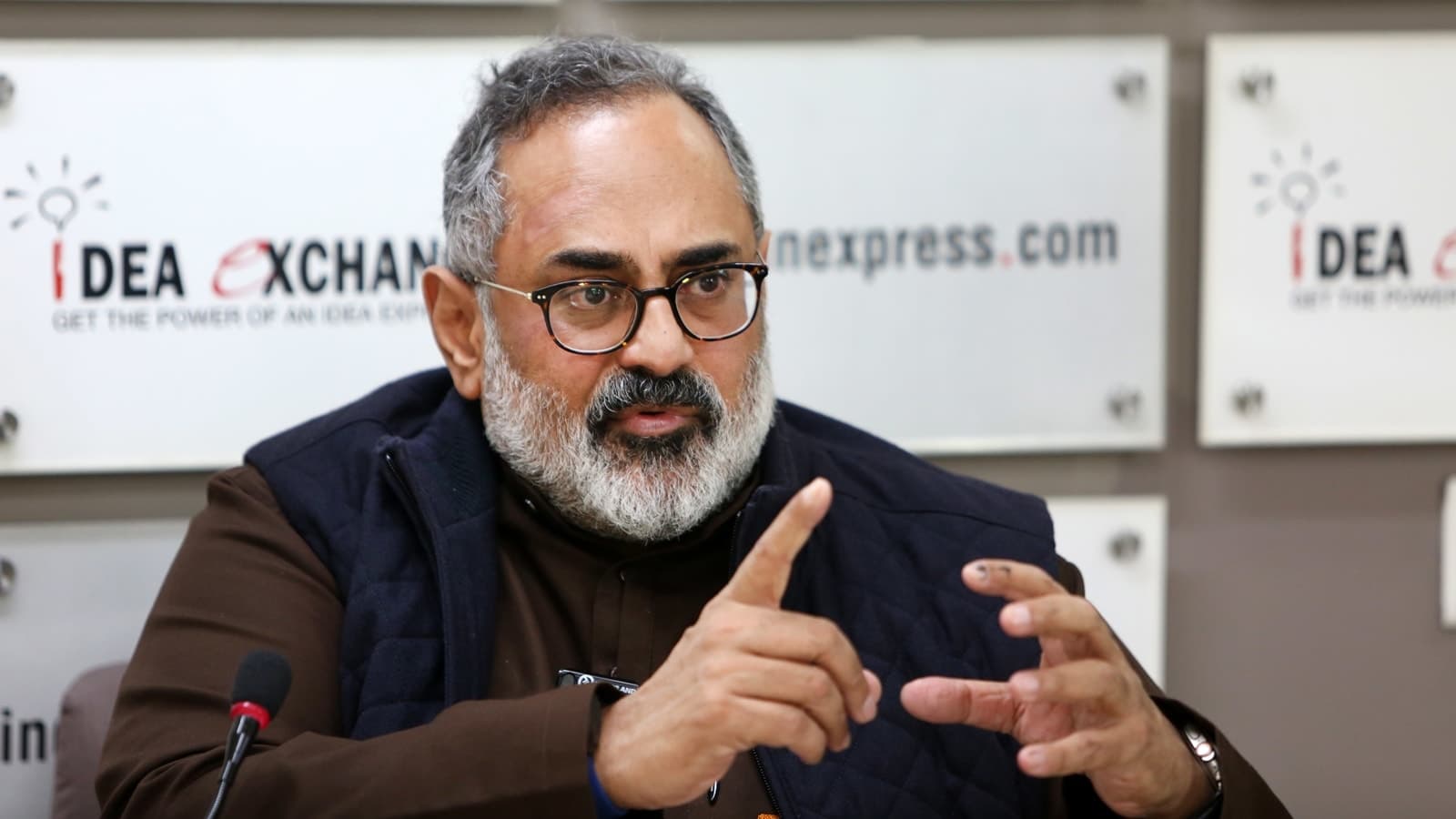
Image: Indian Express
Rajeev Chandrasekhar claims Cockroach Janta Party is a foreign influence operation. Explore the implications for India's democracy and social media's role.
GlipzoRajeev Chandrasekhar, a prominent figure in Indian politics and former Union Minister, has recently made waves with his comments regarding the Cockroach Janta Party (CJP), labeling it as a classic example of a cross-border influence operation aimed at undermining India and Prime Minister Narendra Modi. In an exclusive interview with The Indian Express, Chandrasekhar provided insights into his views on the matter, touching on broader themes of social media's role in politics and the challenges facing Indian democracy.
Chandrasekhar's assertion that the CJP is part of a larger conspiracy is rooted in his observation of emerging social media phenomena. He stated, "I wanted to tell people that there is a need to understand that there are all the signs that this is a very concerted influence operation." While he refrained from pinpointing specific actors behind this operation, he emphasized that the rise of social media, powered by advanced technologies like AI and bots, has made such influence campaigns more prevalent and sophisticated than ever.
The former Minister noted that as India grows on the global stage, it inevitably becomes a target for various forces that may wish to slow down its ascent. He pointed out that the narrative around India's poverty and weakness has shifted dramatically, asserting, "As India’s growth increases, there are many countries that would say, ‘How do we slow down this or how do we put a brake on this growth?’" This perspective raises critical questions about the geopolitical tensions surrounding India’s emergence as a major power.
Chandrasekhar, who actively utilizes social media to communicate, acknowledges its dual nature. He admitted that while social media can democratize opinions and provide direct access to information, it also poses significant risks. Misinformation and manipulation can spread rapidly, causing public discourse to become distorted.
In his words, "Dissent is not particularly a bad thing about democracy. Dissent is something contradictory: opinion, debate, opinion — these are good." However, he cautioned against the weaponization of social media, where narratives can be artificially constructed and amplified using technology. This manipulation not only threatens to destabilize democratic institutions but also undermines genuine public discourse.
When questioned about the appropriateness of blocking dissenting voices online, Chandrasekhar clarified that he does not advocate for censorship as a solution. Instead, he highlighted the importance of discerning genuine dissent from orchestrated influence operations. He remarked, "I am not trying to say every dissent is an influence operation. I am not saying we must suspect every person who has a contradictory view… But we will be very foolish and ignorant if we are not opening our eyes to the fact that there are people who want to create instability and destabilize India."
This nuanced view on dissent underscores the delicate balance democracies must maintain between allowing free expression and guarding against malicious campaigns that aim to disrupt national stability.
Chandrasekhar's analysis of the Cockroach Janta Party suggests that it bears the characteristics of a well-coordinated campaign rather than a spontaneous uprising. He asserted, "With my experience, I can say this has some of the hallmarks of a coordinated influence operation." This assertion raises questions about the motivations behind the CJP and its ultimate goals.
As he elaborated on the potential dangers posed by such movements, he urged the government to investigate the origins and backing of the CJP. The implications of this investigation could have significant ramifications for political discourse in India and the methods by which social media platforms are utilized in political campaigns.
Chandrasekhar's concerns are not merely about the specific incident involving the Cockroach Janta Party; they reflect a broader anxiety about the integrity of Indian democracy in an era dominated by digital communication. As political landscapes evolve, the potential for manipulation and foreign influence grows, challenging traditional concepts of sovereignty and public opinion.
The rise of digital platforms has transformed how political narratives are constructed and disseminated. As India continues to assert its position on the global stage, the interplay between domestic politics and international influence will remain a critical area of concern.
As the conversation around the Cockroach Janta Party unfolds, it presents an opportunity for deeper analysis of how social media is reshaping political engagement in India. Observers will need to watch for: - Government Responses: How will the Indian government address the claims of foreign influence and misinformation? - Public Discourse: Will the public become more aware of the potential manipulations occurring online? - Regulatory Measures: Might there be calls for stricter regulations on social media platforms to combat misinformation?
In conclusion, Rajeev Chandrasekhar's comments serve as a wake-up call about the vulnerabilities in India's democratic fabric. As the nation navigates these challenges, it will be crucial for both leaders and citizens to remain vigilant against the forces that seek to disrupt the democratic process.

Tensions soar as the US and Iran engage in air strikes near the Strait of Hormuz, raising concerns over global oil supply and regional stability.
BBC World
Trump's international interventions face serious stalemates. What will this mean for U.S. foreign policy? Explore the critical challenges ahead.
Indian Express
Tehran denies resignation of President Masoud Pezeshkian amid claims of IRGC influence. What does this mean for Iran's political stability? Click to learn more!
Indian Express