
Image: BBC World
Putin's Victory Day speech justifies the Ukraine war while criticizing NATO. Discover the implications of this year’s scaled-back celebrations.
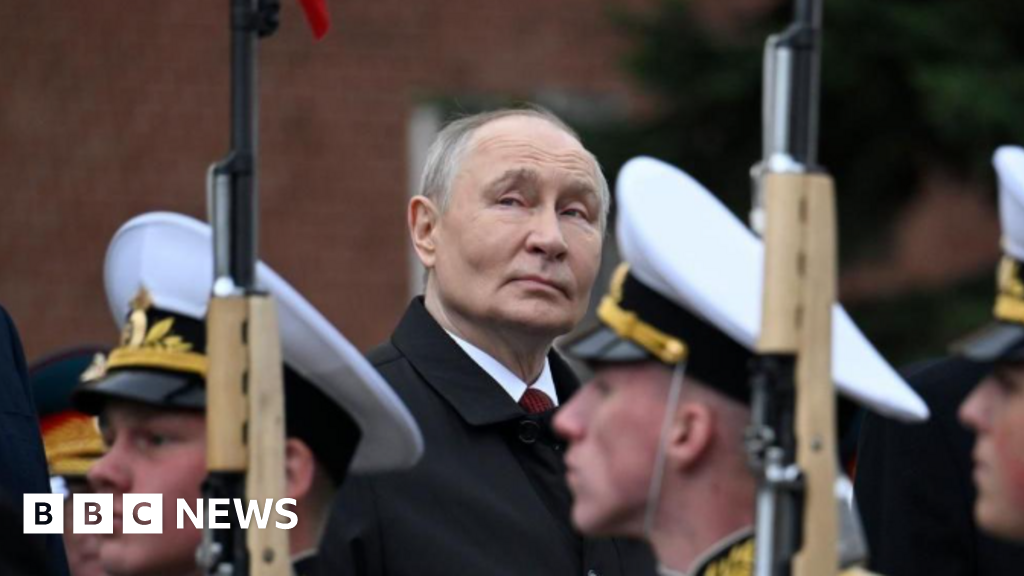
GlipzoIn a highly anticipated speech during the Victory Day celebrations in Moscow, Vladimir Putin took the opportunity to assert his rationale for the ongoing conflict in Ukraine, labeling it a ‘just war’ against what he described as an aggressive force supported by NATO. The event, held on May 9, 2023, in Red Square, saw a noticeable decline in festivities due to heightened security concerns amidst fears of potential Ukrainian attacks.
Greeted by a smaller crowd and under strict security measures, Putin's address was a mix of historical remembrance and contemporary political rhetoric. He emphasized the sacrifices made by the Soviet Union during World War II, stating, “The great feat of the generation of victors inspires the soldiers carrying out the goals of the special military operation today.” This phrase was a direct reference to Russia's ongoing military actions in Ukraine, which have continued for over four years.
Unlike previous years where military parades showcased armored vehicles and ballistic missiles, this year’s event was markedly subdued. Security concerns led to the decision to forgo heavy military hardware in favor of a more traditional display of marching troops. The paraded soldiers, adorned in military attire, marched in formation across Red Square, underscoring Russia's military preparedness without the usual fanfare of heavy machinery.
Following his speech, Putin participated in a series of ceremonial events, including firing cannons and listening to music performed by a military brass band. Notably, foreign dignitaries present included Alexander Lukashenko, President of Belarus, along with Malaysia's King Sultan Ibrahim and Uzbekistan's President Shavkat Mirziyoyev.
The turnout of international leaders was significantly lower compared to the previous year’s 80th anniversary, which had attracted 27 global leaders, including China's President Xi Jinping. This year, only a handful of representatives were in attendance, highlighting the increasingly isolated position of Russia on the world stage. Slovak Prime Minister Robert Fico was notably the only EU leader present, meeting with Putin prior to the event.
Despite the muted celebrations, Putin's speech did not shy away from expressing national pride and solidarity among the Russian people. He praised citizens from various sectors, including scientists and teachers, for their contributions to the war effort, reinforcing his narrative that the nation stands united against external threats.
In a related development, Russia and Ukraine had agreed to observe a three-day ceasefire, a gesture announced by US President Donald Trump just before the celebrations. However, shortly after the parade, Russia's defense ministry accused Ukraine of violating this ceasefire, though no details were provided regarding the incidents. Ukraine has yet to issue a public response, leaving the situation under a cloud of uncertainty.
The context of this year's celebrations was markedly different, not only due to the absence of heavy military equipment but also because of the ongoing conflict that has shifted Russia's focus from commemorating past victories to justifying current military operations. The full-scale invasion of Ukraine, which began in 2022, has reshaped how Victory Day is observed, transforming it into a platform for political messaging.
Victory Day, celebrated annually on May 9, is a pivotal moment in Russia, symbolizing the triumph of the Soviet Union over Nazi Germany. It serves as a national day of remembrance, honoring the sacrifices of millions, including 27 million Soviet citizens who lost their lives during the war. Under Putin's regime, the day has increasingly been utilized as a propaganda tool, showcasing military strength while also reflecting on historical sacrifices.
In recent years, the celebrations have become more than a remembrance; they have served as a stage for Putin to galvanize public support for his military agenda. This year, the message was clear: despite the setbacks and international isolation, Russia remains steadfast in its military endeavors, particularly in Ukraine.
As the dust settles from this year's Victory Day, observers are left to ponder what lies ahead for Russia and its ongoing conflict with Ukraine. The muted celebrations and absence of key international figures signal a shifting geopolitical landscape that could redefine Russia’s role on the global stage.
What will be crucial to watch in the coming weeks is whether the ceasefire holds and what actions both nations will take to either escalate or de-escalate tensions. Additionally, the responses from other countries, particularly NATO members, will influence the trajectory of the conflict and Russia's military strategy moving forward.
As tensions continue to simmer, the international community remains vigilant, monitoring the situation closely and preparing for potential ramifications on global security and diplomacy.

Tensions soar as the US and Iran engage in air strikes near the Strait of Hormuz, raising concerns over global oil supply and regional stability.
BBC World
Trump's international interventions face serious stalemates. What will this mean for U.S. foreign policy? Explore the critical challenges ahead.
Indian Express
Tehran denies resignation of President Masoud Pezeshkian amid claims of IRGC influence. What does this mean for Iran's political stability? Click to learn more!
Indian Express