
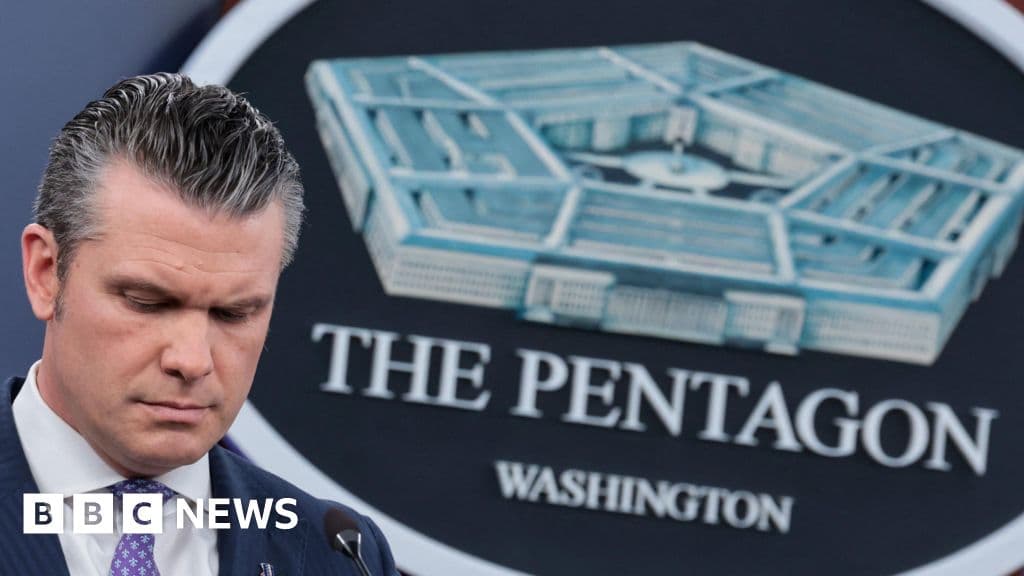
Image: BBC Business
The U.S. military's shift to an 'AI-first' strategy marks a critical evolution in defense technology, partnering with major tech firms for enhanced operational capabilities.
GlipzoThe U.S. military is set to significantly enhance its integration of artificial intelligence (AI) into its operations, following the Pentagon's announcement of new contracts with leading tech firms. These agreements, which include collaborations with Google, OpenAI, Amazon, Microsoft, SpaceX, Oracle, Nvidia, and the startup Reflection, aim to transform the military into an 'AI-first' fighting force. The Pentagon emphasized that AI technology will now be employed for any ‘lawful operational use,’ marking a substantial shift in how military operations are conducted.
The Pentagon's strategic partnership with these tech giants is designed to enhance its capabilities without becoming overly reliant on a single provider, a scenario referred to as 'vendor lock.' This diverse approach seeks to ensure access to a wide array of AI technologies that can empower soldiers in the field, enabling them to respond effectively to various challenges and threats. The Pentagon stated, "Access to a diverse suite of AI capabilities from across the resilient American technology stack will give warfighters the tools they need to act with confidence and safeguard the nation against any threat."
Since the launch of the military’s AI platform last year, over one million personnel across the Department of Defense have utilized this technology, significantly reducing the time needed for many tasks from months to mere days. This illustrates the growing importance of advanced technology in modern warfare, as the Pentagon has been actively working on enhancing its AI capabilities for several years.
Notably absent from this alliance is Anthropic, a company that has expressed concerns regarding the potential military applications of its AI tools. The firm is currently embroiled in a legal dispute with the Pentagon, alleging retaliation after it declined to accept contract language that permitted 'any lawful use' of its technology. This conflict has put a spotlight on the ethical implications of deploying AI in military and surveillance contexts. Anthropic’s CEO, Dario Amodei, has publicly voiced fears about the risks of mass domestic surveillance and the deployment of autonomous weapons, leading to the Pentagon designating the company as a “supply chain risk.”
Anthropic's ongoing legal challenge is scheduled to go to court in September, and its absence from the Pentagon's recent initiatives may open the floor for other AI firms to strengthen their ties with the military. In fact, OpenAI was the first company to secure a contract with the Pentagon following the fallout with Anthropic, formalizing its agreement at the end of February. A spokesperson for OpenAI reaffirmed their commitment to ensuring that national defense personnel have access to top-tier resources.
While Google's AI model, Gemini, has already been utilized in some government sectors, this new arrangement marks the first time it will be applied to classified government work. Following the Pentagon's announcement, hundreds of Google employees, including many from its AI development division, DeepMind, expressed their concerns about deepening collaboration with the military in a letter directed to CEO Sundar Pichai. The internal dissent highlights the ethical quandaries surrounding AI applications in military contexts.
SpaceX, now the parent company of xAI, the AI startup founded by Elon Musk, is also part of the military's AI strategy. While SpaceX has developed the AI chatbot Grok, its capabilities are considered to be less advanced compared to the offerings from Anthropic, OpenAI, and Google. However, SpaceX has yet to provide comments regarding its involvement with military AI initiatives.
The integration of Nvidia and Reflection's open-source AI models into military operations signifies a pivotal moment in the U.S. military's approach to technology. The use of sophisticated tools like Nemotron and Reflection 70B is expected to enhance operational efficiency and decision-making processes. As the Pentagon continues to embrace AI, the implications for military strategy and national security are profound.
As the legal battles between Anthropic and the government unfold, and as broader discussions about the ethical use of AI in warfare continue, the outcome may reshape the landscape of military technology partnerships. The focus on AI tools reflects a significant shift toward leveraging advanced technology in defense strategies, and stakeholders will be watching closely to see how these developments evolve.
The Pentagon's commitment to becoming an AI-first military force represents a critical juncture in the intersection of technology and defense. As nations around the world race to harness the advantages of AI, the implications for global security, ethical considerations, and the future of warfare are vast. The partnerships formed today could influence military strategies for decades to come.
As the military navigates this new terrain, the balance between leveraging AI for national security and addressing ethical concerns will be crucial in shaping the future of warfare.

Tensions soar as the US and Iran engage in air strikes near the Strait of Hormuz, raising concerns over global oil supply and regional stability.
BBC World
Trump's international interventions face serious stalemates. What will this mean for U.S. foreign policy? Explore the critical challenges ahead.
Indian Express
Tehran denies resignation of President Masoud Pezeshkian amid claims of IRGC influence. What does this mean for Iran's political stability? Click to learn more!
Indian Express