
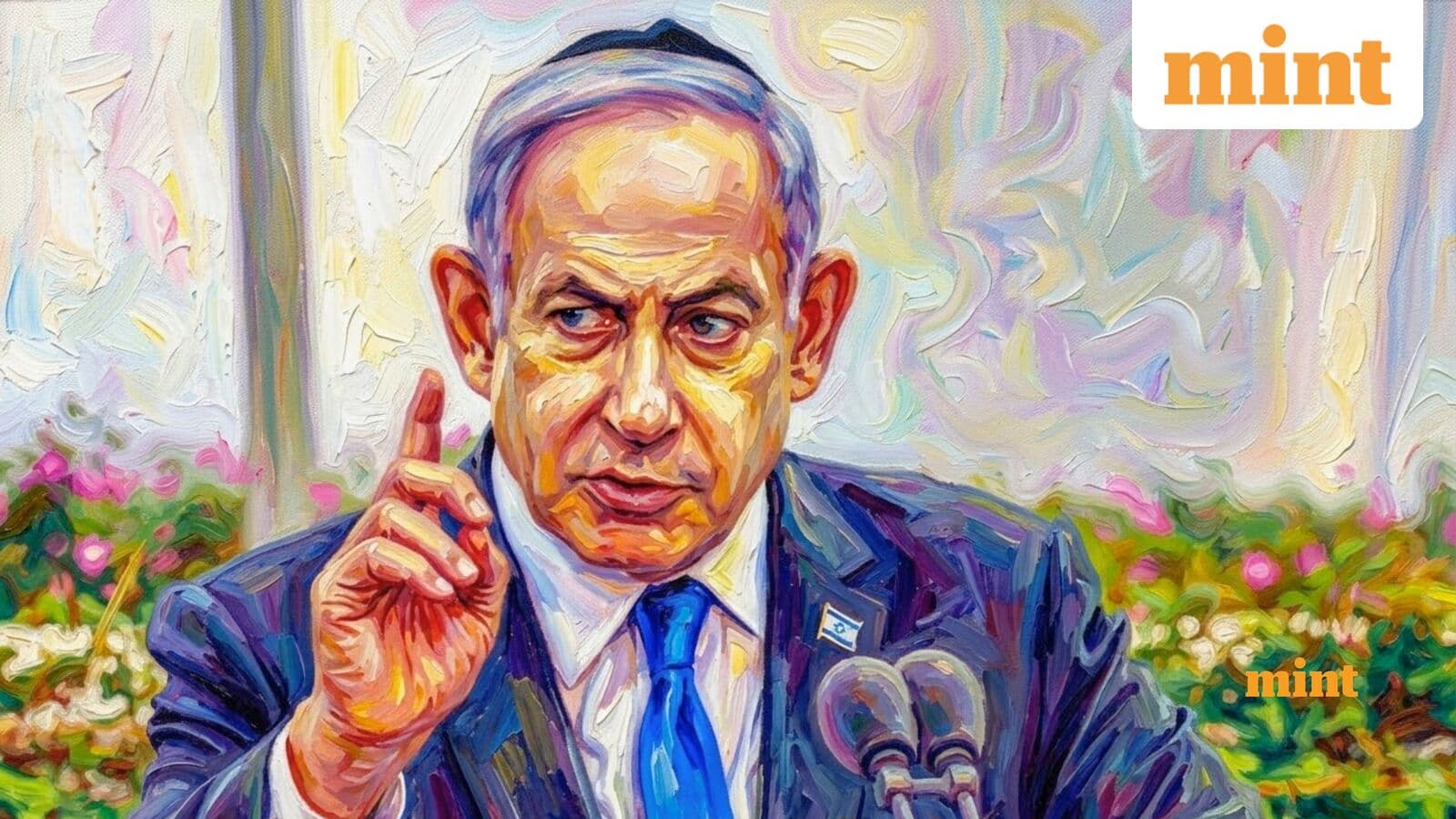
Image: Mint (Business)
Explore Netanyahu's controversial quote and its implications on the ongoing Israel-Iran conflict. What does it reveal about the Israeli-Palestinian situation?
GlipzoIn a world where political rhetoric often shapes realities, Israeli Prime Minister Benjamin Netanyahu's statement—"If the Arabs put down their weapons today, there would be no more violence. If the Jews put down their weapons today, there would be no more Israel"—stands out as one of the most provocative assertions regarding the Israeli-Palestinian conflict. This quote, uttered in a tense political landscape, has sparked heated debates and reflections on the ongoing violence between Israel and Iran, particularly as the conflict intensifies.
Netanyahu's claim is more than a mere soundbite; it encapsulates his vision of Israel’s survival. He posits that Israel’s existence hangs in the balance on its ability to defend itself against adversaries, portraying armed resistance as the primary catalyst for violence. This perspective suggests that peace is a unilateral choice, resting solely with those who oppose Israel.
However, the statement is far from universally accepted. Critics argue that it oversimplifies a complex situation by ignoring crucial historical contexts, such as decades of occupation, displacement, and the blockades that Palestinians have endured. By placing the moral burden on one side, Netanyahu’s rhetoric is seen as dismissive of the broader realities faced by Palestinians and the violence they experience.
On the flip side, supporters of Netanyahu's viewpoint contend that his assessment highlights a significant asymmetry in the conflict. They point out that various Palestinian factions have openly expressed intentions to obliterate Israel, while Israel has consistently sought peace through negotiations. This dichotomy underscores the contentious nature of the ongoing struggle, painting it in stark black-and-white terms.
Though widely attributed to Netanyahu, the origins of this quote are somewhat murky. Some researchers have traced similar sentiments back to earlier leaders, including the former Israeli Prime Minister Golda Meir. Despite the uncertainty surrounding its first use, the quote has morphed into a potent symbol of Netanyahu's governance and foreign policy.
In recent years, the implications of this statement have extended beyond Palestinian armed groups to encompass the growing Iran-Israel tensions. As the two nations have engaged in a series of direct confrontations, the quote’s logic has evolved into a broader foreign policy stance that sees Iran as a significant threat to Israel’s existence.
The Iran-Israel proxy conflict intensified dramatically in 2024, culminating in direct military confrontations. By June 2025, this tense standoff escalated into open warfare, marking a critical turning point in the geopolitical landscape of the Middle East. The stakes were raised on February 28, 2026, when Israel, in coordination with the United States, launched extensive strikes against Iranian infrastructure, following failed nuclear negotiations.
This marked the beginning of a full-scale war, which has become the most sustained military conflict between Israel and Iran in history. As Netanyahu further justifies his stance through the lens of this conflict, his quote resonates with those who believe in the legitimacy of Israel’s security concerns while simultaneously frustrating those who perceive a cycle of provocation and retaliation that both parties contribute to.
The ramifications of this conflict extend far beyond political maneuvering; they deeply affect civilian populations on all sides. The human toll is substantial, with ordinary citizens in Gaza, Lebanon, and Iran suffering the consequences of the ongoing violence. While Iran's hostility toward Israel is well-documented, the devastation experienced by these communities highlights the tragic human reality behind political rhetoric.
No single quote can encapsulate the complexities of the Israeli-Palestinian conflict or the tensions with Iran. Nevertheless, Netanyahu's statement serves as a guiding principle for his administration, framing Israel's actions and responses in a manner that underscores perceived existential threats.
As the conflict continues to evolve, the repercussions of Netanyahu's rhetoric will likely shape future engagements in the region. The strategic landscape is shifting, and with ongoing hostilities, observers will need to remain vigilant about potential escalations. The international community's response to these developments will also be crucial in determining whether pathways to peace can emerge or if the cycle of conflict will persist.
In summary, Netanyahu's quote embodies the fears and justifications surrounding Israel's existence in a hostile region. It serves as a reminder of the complexities inherent in the Israeli-Palestinian conflict and the broader geopolitical dynamics at play. As tensions rise and new confrontations arise, the world will be watching closely to see how this narrative unfolds in the coming years.

Tensions soar as the US and Iran engage in air strikes near the Strait of Hormuz, raising concerns over global oil supply and regional stability.
BBC World
Trump's international interventions face serious stalemates. What will this mean for U.S. foreign policy? Explore the critical challenges ahead.
Indian Express
Tehran denies resignation of President Masoud Pezeshkian amid claims of IRGC influence. What does this mean for Iran's political stability? Click to learn more!
Indian Express