
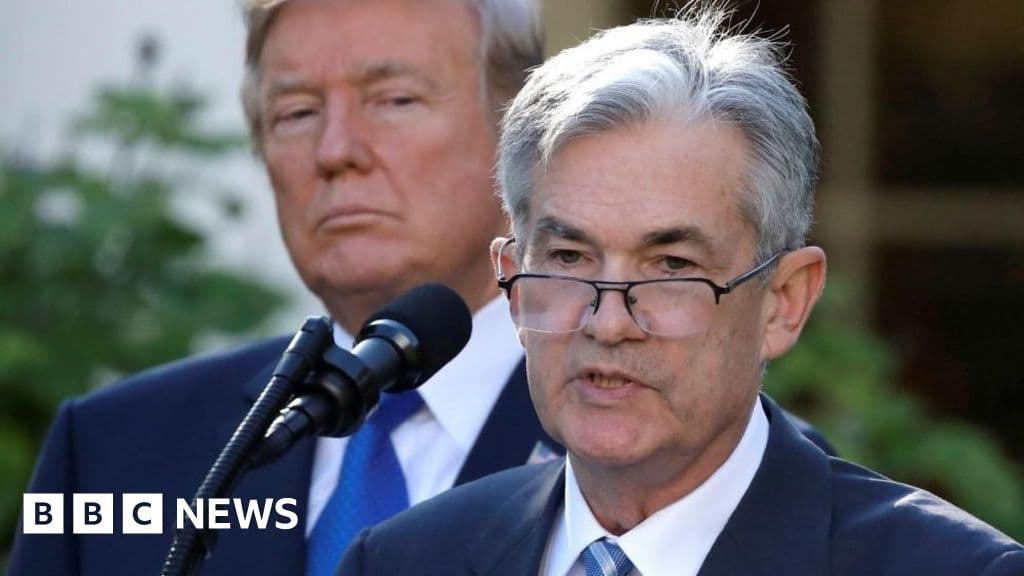
Image: BBC Business
The US Justice Department has closed its investigation into Jerome Powell, paving the way for new leadership at the Federal Reserve amid political tensions.
GlipzoIn a significant development, the US Justice Department has decided to discontinue its investigation into Federal Reserve Chairman Jerome Powell regarding alleged cost overruns on building renovations. This conclusion marks a pivotal moment in an ongoing saga involving Powell, President Donald Trump, and the broader implications for the Federal Reserve's governance.
The announcement came from US Attorney Jeanine Pirro, who stated that rather than pursuing criminal charges, an internal review would be conducted by the central bank's inspector general. This shift in approach underscores the complexities surrounding the investigation, particularly in light of the political climate and ongoing tensions between the Fed and the Trump administration.
The investigation into Powell's handling of renovation costs has been a focal point in a larger feud between him and President Trump. Trump has been vocal about his dissatisfaction with the expenses associated with the Federal Reserve's building upgrades, which he claims have ballooned to $3.1 billion, significantly above the Fed's initial estimate of $2.5 billion.
This situation has been further complicated as Powell's term nears its conclusion. The Senate is currently evaluating Trump's nominee for Powell's successor, Kevin Warsh. Notably, Republican Senator Thom Tillis has indicated he would withhold support for Warsh unless the administration dropped its inquiry into Powell. This political maneuvering highlights the high stakes involved in the leadership of the Federal Reserve, especially as monetary policy continues to play a crucial role in the US economy.
In a recent statement, Kush Desai, a spokesperson for the White House, emphasized the need for accountability regarding the Federal Reserve's financial management. He stated, "American taxpayers deserve answers about the Federal Reserve's fiscal mismanagement, and the Office of the Inspector General's more powerful authorities best position it to get to the bottom of the matter."
Desai expressed confidence in the Senate's ability to confirm Warsh, asserting that this change in leadership would restore competence and confidence within the Fed's decision-making processes. This confidence is crucial as the Federal Reserve navigates economic challenges and public scrutiny of its policies.
In light of the investigation's unprecedented nature, Powell took the unusual step of releasing a video in January. In it, he disclosed that the Justice Department had issued subpoenas to the Fed and threatened a criminal indictment regarding his testimony before a Senate committee on the renovation costs. Powell expressed concerns that this investigation stemmed from Trump's frustration over the Fed's refusal to cut interest rates, which the president has consistently pushed for.
Powell's remarks highlighted a critical issue: the independence of the Federal Reserve. He stated, "This is about whether the Fed will be able to continue to set interest rates based on evidence and economic conditions, or whether instead monetary policy will be directed by political pressure or intimidation." This assertion underscores the delicate balance between political influence and economic governance.
Interest rates play a pivotal role in the economy, affecting borrowing costs and spending behavior. Lower interest rates typically encourage borrowing and spending, stimulating economic growth, while higher rates can dampen financial activity to stabilize prices. Trump's experiences as a property developer have likely influenced his preference for lower rates, as he has repeatedly criticized the Fed for raising rates during his presidency.
The renovation project itself involves crucial updates to the Eccles and 1951 Constitution Avenue buildings, modernizing facilities that have not seen significant improvements since their construction in the 1930s. This includes necessary remediation of hazardous materials such as asbestos and lead, which is essential for both safety and operational efficiency.
As Powell's term approaches its end on May 15, he plans to remain in his position until Warsh is confirmed by the Senate. This transition period will be critical as the Fed faces ongoing scrutiny over its decisions and performance. Trump's recent threats to fire Powell if he does not resign add another layer of complexity to the situation, raising questions about the potential for further political intervention.
Looking ahead, the Senate's confirmation process for Warsh will be a key event to watch. If confirmed, Warsh will be stepping into a challenging role as he navigates the intricate relationship between the Fed, the Trump administration, and the broader economic landscape. Moreover, the results of the inspector general's review will likely be closely monitored, as they may influence public perception and future policies of the Federal Reserve.
In conclusion, the closure of the investigation into Powell provides a temporary reprieve for the Federal Reserve chairman. However, the ongoing political dynamics and the upcoming leadership transition suggest that the Fed will remain at the center of public and political discourse. As the economy continues to evolve, the decisions made by the Federal Reserve will be scrutinized more than ever, emphasizing the importance of maintaining its independence and credibility in the eyes of the American public.

Tensions soar as the US and Iran engage in air strikes near the Strait of Hormuz, raising concerns over global oil supply and regional stability.
BBC World
Trump's international interventions face serious stalemates. What will this mean for U.S. foreign policy? Explore the critical challenges ahead.
Indian Express
Tehran denies resignation of President Masoud Pezeshkian amid claims of IRGC influence. What does this mean for Iran's political stability? Click to learn more!
Indian Express