
Image: BBC World
Greenlanders protest against U.S. influence as tensions rise over sovereignty. Discover the implications of this growing diplomatic crisis.
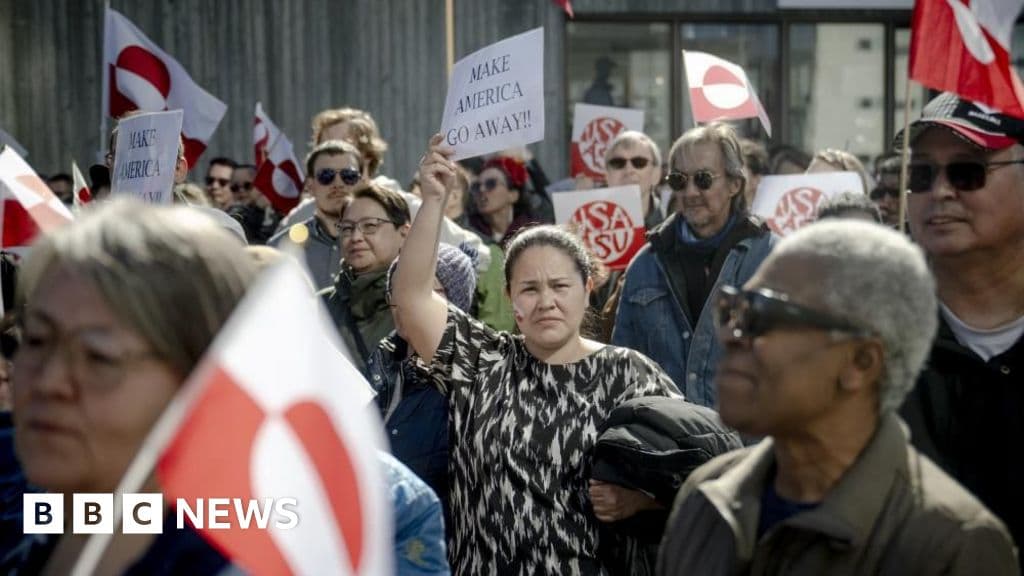
GlipzoOn a chilly Friday afternoon, hundreds of Greenlandic citizens assembled outside the newly inaugurated U.S. consulate in Nuuk, the island's capital, voicing their opposition to former President Donald Trump's aspirations regarding Greenland's future. This protest unfolded during a week marked by the visit of Jeff Landry, Trump's envoy to Greenland, who aimed to foster U.S.-Greenland relations despite the contentious backdrop.
The demonstration was organized by Aqqalukkuluk Fontain, who made it clear that the message was unambiguous: "Our government already told Donald Trump and his administration that Greenland is not for sale." This sentiment resonates deeply among Greenlanders, who feel the weight of external influence on their semi-autonomous territory, which is part of Denmark.
The crowd, which included community leaders, activists, and everyday citizens, marched through the heart of Nuuk, chanting slogans such as "Greenland is for Greenlanders". The protest culminated in a powerful display of unity as participants turned their backs to the consulate in silent protest.
Fontain expressed the broader implications of their demonstration, stating, "Our message is for the American people and to the rest of the world. That in a democratic world, no means no." This protest not only aimed to assert Greenland's right to self-determination but also to remind the world of the island's cultural identity and political autonomy.
Among the protesters, Inge Bisgaard articulated the sentiment of many when she criticized Landry’s visit as disrespectful. She recalled the anxiety sparked by Trump’s earlier claims about “owning” Greenland and emphasized the importance of showing dissent against such attitudes, saying, "It's so important to show this is not okay." Another participant, Parnuna Olsen, raised the question that is on many minds: "Why does the U.S. need a consulate in Greenland at all?"
The inauguration of the consulate and Landry’s trip come at a time of heightened diplomatic tensions. Following Trump's controversial proposal to purchase Greenland in 2019, the U.S. has sought to increase its presence in the Arctic region, citing national security concerns. This has raised eyebrows and stirred fear among Greenlanders, who are keen to protect their sovereignty.
Landry’s visit was characterized by a lack of formal invitation, which added to the unease. Despite being a close ally of Trump and the Governor of Louisiana, his role came under scrutiny as he navigated a complex landscape of political sensitivities. Following his trip, Landry returned to Washington, D.C., reportedly to meet with Trump, indicating that discussions regarding Greenland's status are far from over.
The new consulate, often referred to by locals as “Trump Towers”, occupies a prominent space in downtown Nuuk, spanning 3000 square meters. Its grand opening featured a performance of the American national anthem and an unveiling of a plaque by Kenneth Howery, the U.S. Ambassador to Denmark. During the ceremony, Howery expressed a desire for a “deeper partnership” with Greenland, highlighting the Arctic's growing global significance.
Despite these gestures, the absence of key Greenlandic politicians, including Prime Minister Jens-Frederik Nielsen and several cabinet ministers, was telling. MP Naaja Nathanielsen declined the invitation, stating, "I think that right now it's about sending signals.” This absence reflects a broader reluctance among Greenlandic leaders to engage with U.S. officials under the current circumstances.
During his brief stay, Landry attended a business summit but spent little time engaging with the local community, which has raised questions about the sincerity of U.S. intentions. In a conversation with Sermitsiaq, a local publication, Landry stirred controversy by suggesting that Greenland could thrive as an independent nation, stating, "I think Greenland could have an equally good or even better economy as an independent country."
When pressed about respecting Greenland's sovereignty, Landry’s response hinted at a complex relationship, emphasizing that “there is only one line for us. It is red, white, and blue.” This comment has fueled concerns about the U.S. agenda in the Arctic, as Greenlanders grapple with their identity and future.
The White House has remained tight-lipped about the specifics of Trump's discussions with Landry, but a spokesperson conveyed optimism regarding addressing U.S. national security interests in Greenland. As tensions simmer, the situation remains fluid.
The protest in Nuuk is more than a local event; it underscores a critical moment in international relations and the ongoing struggle for indigenous rights and self-determination. Greenland's pushback against perceived external interference is a powerful reminder of the complexities involved in Arctic politics and the need for respectful dialogue.
As both Greenland and the United States navigate this delicate relationship, the outcomes will likely influence not only local governance but also global strategies in the Arctic region.
As we look to the future, all eyes will be on how diplomatic relations between Greenland and the United States evolve in light of these protests and the ongoing discussions about Greenland's autonomy. The sentiment among Greenlanders indicates a strong desire for respect and recognition, which could shape the course of U.S.-Greenland relations significantly in the years to come.

Tensions soar as the US and Iran engage in air strikes near the Strait of Hormuz, raising concerns over global oil supply and regional stability.
BBC World
Trump's international interventions face serious stalemates. What will this mean for U.S. foreign policy? Explore the critical challenges ahead.
Indian Express
Tehran denies resignation of President Masoud Pezeshkian amid claims of IRGC influence. What does this mean for Iran's political stability? Click to learn more!
Indian Express