
Image: BBC World
French PM Sébastien Lecornu's bakery visit on Labour Day sparks controversy, reigniting debates on workers' rights and holiday regulations in France.
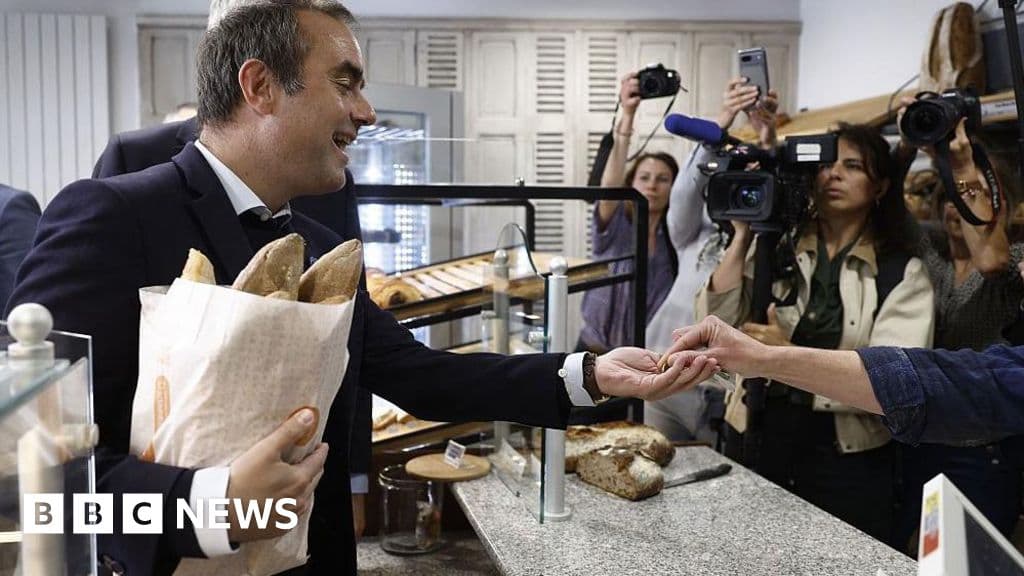
GlipzoIn a surprising turn of events, French Prime Minister Sébastien Lecornu has found himself at the center of a heated debate after he was spotted purchasing baguettes in a local bakery on Labour Day, May 1st. This seemingly innocuous trip to a bakery in Saint-Julien-Chapteuil quickly ignited tensions with labor unions, who staunchly believe that May 1st should remain a mandatory day of rest for all workers.
During his visit, Lecornu made light of the situation, cheerfully requesting, "Let's have several... at least four,” while also picking up flowers from a local shop. This gesture, however, has been interpreted by many as a political stunt rather than a genuine show of support for local businesses.
The backdrop to this controversy is the government's recent initiative aimed at allowing independent bakeries and flower shops to operate on Labour Day, a public holiday that traditionally sees most businesses closed. Under French labor law, only essential services such as hospitals and hotels are permitted to remain open, with employees receiving double wages for their work on this day.
The current ambiguous status of bakeries and florists in this context has led to confusion among both employers and employees. In response to the Prime Minister's actions, Marylise Léon, General Secretary of France's leading labor union, criticized the visit, stating, "Politicians going to a bakery, I think that's part of a political spectacle that we don't need today. We need to show what the reality of a bakery worker is like."
Compounding the situation, Lecornu reached out to a baker named Eric, who had received a fine for keeping his shop open on Labour Day. The Prime Minister assured him that he would not have to pay the hefty penalty of €5,250 (approximately $6,168) that was imposed for failing to adhere to labor regulations. This fine included €750 for each of his seven employees who worked that day.
This direct intervention by the Prime Minister highlights the government's supportive stance towards bakers who wish to operate on public holidays, despite the risks involved. As part of a larger legislative proposal, the government has introduced a bill that would allow such businesses to open on Labour Day, provided employees voluntarily agree to work and are compensated at double the usual rate.
Despite the government’s push, labor unions have expressed deep concerns regarding the implications of this legislation. They argue that the notion of voluntary work may not hold up in practice, as employees could feel pressured by their employers to work on public holidays, jeopardizing their job security if they refuse.
The unions have warned that if this trend continues, it could set a dangerous precedent, leading to an erosion of workers' rights across France. In a joint statement issued in April, unions noted, "Social history shows us that each time a principle is undermined, exemptions gradually increase until they become the rule."
As the French government pushes for this new legislation, the debate over workers' rights and holiday regulations is far from settled. The proposal still requires parliamentary approval, and it remains to be seen how lawmakers will respond to the mounting pressure from both unions and business owners.
Looking ahead, stakeholders and citizens alike should monitor the developments closely. The outcome of this legislation could reshape the landscape of labor rights in France, particularly regarding public holidays. It raises critical questions about the balance between supporting small businesses and ensuring the protection of workers' rights.
The ongoing dialogue between government officials and labor unions will be pivotal in determining the future of holiday regulations and could influence similar discussions in other sectors. As the debate unfolds, it will be essential for both parties to find common ground that respects the labor rights historically hard-won by workers throughout the country.
In conclusion, the Prime Minister's bakery visit has served as a flashpoint for broader discussions about labor laws in France, and the implications of these policies will be felt well beyond the bakery doors. What happens next in this ongoing saga will be critical to watch, as it may set a precedent for how public holidays are treated in the future.

Tensions soar as the US and Iran engage in air strikes near the Strait of Hormuz, raising concerns over global oil supply and regional stability.
BBC World
Trump's international interventions face serious stalemates. What will this mean for U.S. foreign policy? Explore the critical challenges ahead.
Indian Express
Tehran denies resignation of President Masoud Pezeshkian amid claims of IRGC influence. What does this mean for Iran's political stability? Click to learn more!
Indian Express