
Image: BBC World
Ecuador's President Noboa faces backlash for meddling in Colombia's election by promising tariff lifts. What does this mean for Colombia's future?
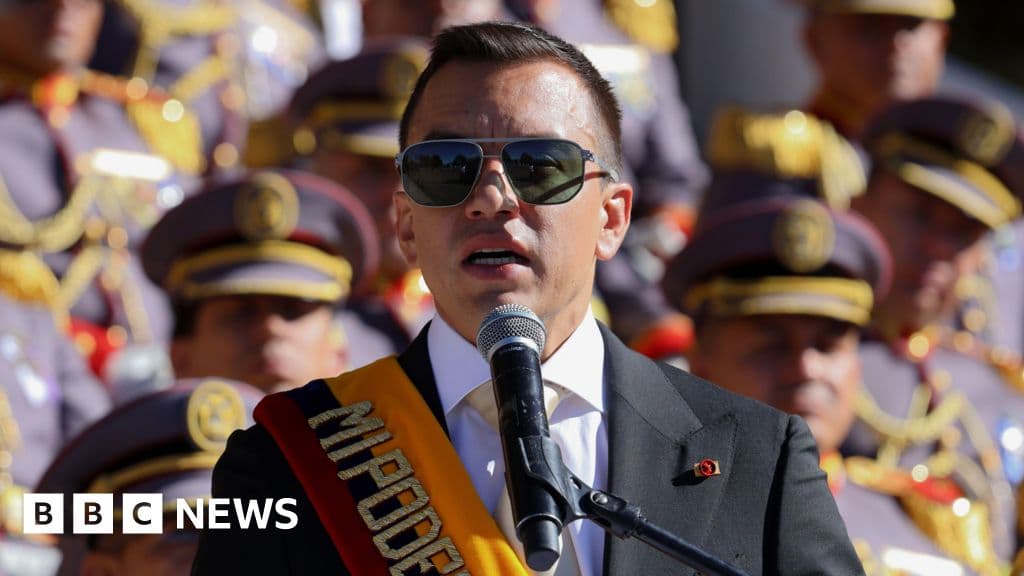
GlipzoIn a significant political turn, Colombia's foreign ministry has accused Ecuador's President Daniel Noboa of engaging in deliberate interference ahead of Colombia's presidential election on Sunday. Noboa's recent promise to lift tariffs for Colombian goods, made during a conversation with right-wing candidate Abelardo de la Espriella, has sparked outrage in Bogotá. The timing of this promise is particularly sensitive, as Colombia grapples with intense political polarization and rising violence from drug gangs.
This accusation comes amidst a backdrop of Colombia's impending election, which holds the potential to reshape its international alliances and domestic policies. The current atmosphere is charged, with President Gustavo Petro, Colombia's first leftist leader, unable to seek re-election. His administration has been marked by tensions with the United States, particularly over issues related to drug trafficking and military interventions. As Colombia prepares to elect a new leader, the fallout from Noboa's comments could have far-reaching ramifications.
In a statement following his discussion with de la Espriella, Noboa announced plans to eliminate tariffs on Colombian imports effective June 1. He framed this agreement as beneficial for both nations, emphasizing cooperation on trade and security matters. However, this move comes against a backdrop of Ecuador's recent history of imposing tariffs on Colombian products, a measure taken in response to Bogotá's inability to control their shared border effectively.
Ecuador's strategic location, nestled between Colombia and Peru—the world's leading cocaine producers—has turned it into a critical transit nation for illicit drugs. The tariff imposition was aimed at addressing the spillover effects of Colombia's drug violence. Therefore, Noboa's sudden change of heart raises questions about the motivations behind his diplomatic overture and its timing.
Colombia's foreign ministry swiftly condemned Noboa's actions, labeling them as a flagrant violation of non-intervention principles. They characterized the lifting of tariffs as a misleading gesture rather than a genuine goodwill measure. In their statement, they underscored that this interference poses a threat to Colombia's national sovereignty and democratic integrity.
The political landscape in Colombia has been historically dominated by centrist technocrats. However, the election of Gustavo Petro marked a shift toward leftist politics, igniting fierce debates over national security and drug policies. As Colombia heads to the polls, the elections are anticipated to be closely contested, with no single candidate expected to secure a majority, leading to a possible runoff on June 21.
Polling indicates that Iván Cepeda, Petro's endorsed successor, is leading the race, with de la Espriella positioned as a strong competitor. Cepeda has committed to continuing Petro's total peace initiative, which focuses on negotiating with armed groups involved in drug trafficking. However, this strategy has faced significant challenges, with past agreements collapsing amid renewed violence.
In contrast, de la Espriella and Paloma Valencia, the center-right candidate, have pledged to adopt a more militarized approach to combat the growing influence of drug cartels. Following Noboa's earlier efforts to deploy 75,000 police officers in Ecuador to address violence, such promises resonate with a public seeking immediate action against crime.
As Colombia's political candidates campaign, they face an environment marked by violence, with notable incidents affecting the safety of candidates. Notably, one candidate was killed last summer, and de la Espriella has taken precautions by appearing at rallies behind bulletproof glass. This alarming trend underscores the challenges faced by candidates in a country grappling with drug-related violence and political instability.
Both de la Espriella and Valencia have expressed a desire to strengthen Colombia's security alliance with the United States, a relationship that has deteriorated under Petro's administration. In contrast, Cepeda has echoed sentiments from Petro, advocating for Colombia's autonomy and opposing the notion of becoming a

Tensions soar as the US and Iran engage in air strikes near the Strait of Hormuz, raising concerns over global oil supply and regional stability.
BBC World
Trump's international interventions face serious stalemates. What will this mean for U.S. foreign policy? Explore the critical challenges ahead.
Indian Express
Tehran denies resignation of President Masoud Pezeshkian amid claims of IRGC influence. What does this mean for Iran's political stability? Click to learn more!
Indian Express