
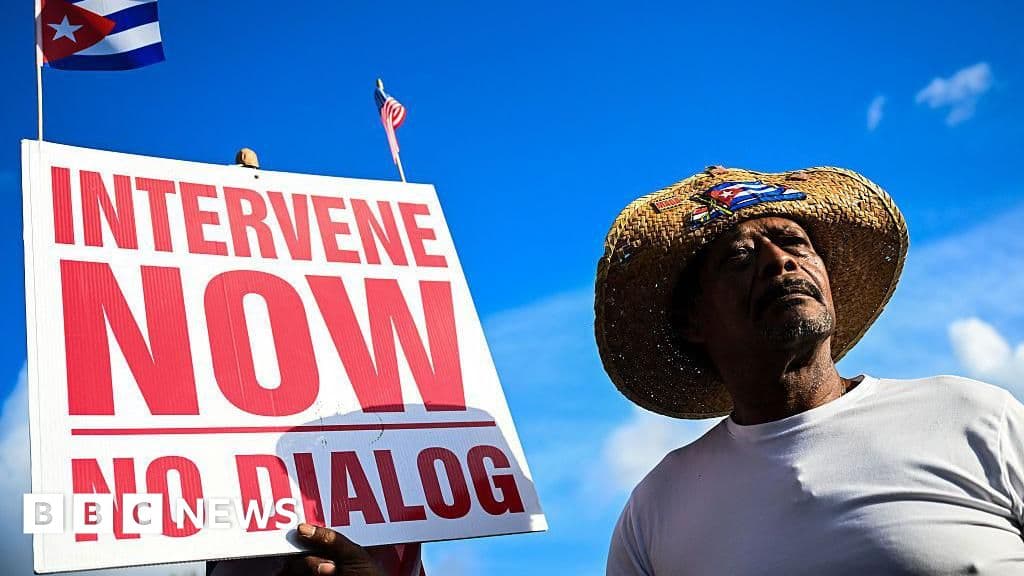
Image: BBC World
The indictment of Raúl Castro sparks speculation around Cuba's future. What does this mean for U.S. relations and potential regime change?
GlipzoIn a shocking move that has sent ripples through international relations, the United States has officially charged Raúl Castro, the former president of Cuba and a pivotal figure in the country’s Communist regime, with murder. This indictment, stemming from the 1996 shootdown of two civilian aircraft by Cuban military jets, raises significant questions about the future of Cuba and its leadership amidst a growing chorus of calls for regime change from Washington. As the 94-year-old Castro faces these serious allegations, speculation abounds regarding the potential repercussions for the island nation just 90 miles from U.S. shores.
Amid a maximum pressure campaign that has plunged Cuba into its worst fuel and energy shortages in decades, U.S. officials are increasingly vocal about their desire to see the end of the 66-year-old Communist government. While President Donald Trump has stated he does not foresee any necessary escalation, he has also emphasized that the U.S. will not tolerate the existence of a rogue state so close to its borders.
What lies ahead for Cuba is uncertain, with three major scenarios being considered: the potential for economic collapse, internal strife, or even possible military intervention by the U.S. Each of these outcomes carries significant implications not just for Cuba, but also for U.S. foreign policy in the region.
The indictment of Castro has sparked immediate speculation about the possibility of U.S. military action aimed at capturing him and bringing him to justice in an American courtroom. This idea is not entirely without precedent. In January, U.S. commandos executed a rapid operation in Venezuela to apprehend President Nicolás Maduro, a close ally of Cuba, due to drug and weapons charges.
Historically, the U.S. has intervened in Latin America before; notably, in 1989, thousands of troops invaded Panama in an operation to oust Manuel Noriega. While President Trump has downplayed the idea of a similar operation in Cuba, some lawmakers are urging action. Florida Senator Rick Scott stated, "We shouldn't take anything off the table. The same thing that happened to Maduro should happen to Raul Castro."
Experts acknowledge that while a military operation to capture Castro could be executed, it comes with considerable risks. Adam Isacson, a regional specialist with the Washington Office on Latin America, pointed out that Castro's advanced age and heavy security detail complicate such a mission. He noted, "In some ways, it might be easier to extract him, but the risks are significant."
While capturing Castro might be feasible, the actual impact on the Cuban government could be minimal. Following his resignation as president in 2018, many have viewed him more as a symbolic figure than a central authority in the regime. Isacson noted, "Removing him wouldn’t affect the power structure in Cuba very much. He’s 94. The influence of the Castro family remains, but it's not as central as it once was."
However, the symbolic act of capturing a revolutionary figure from 1959 could have profound effects on domestic politics in Cuba. The potential to humiliate the Castro legacy appeals to U.S. officials, but the strategic benefits of such a move remain questionable. Experts warn that, even if Castro were captured, it may not disrupt the entrenched Communist government.
Another possibility floated by U.S. officials, including President Trump, is a transition to new leadership in Cuba. This scenario could mirror the replacement of Maduro with Delcy Rodriguez in Venezuela, allowing the regime to remain largely intact while establishing a working relationship with the U.S. Trump has claimed that he is in discussions with figures in Cuba who are seeking U.S. assistance as the nation grapples with its ongoing economic crisis.
On May 12, Trump stated, "Cuba is asking for help, and we are going to talk." Following this, CIA Director John Ratcliffe met with Cuban officials, including Castro's grandson, Raúl Guillermo Rodríguez Castro, to discuss future relations. Secretary of State Marco Rubio remarked, "We’ll engage with the Cubans... they need to make a decision. Their system just doesn’t work."
The desired changes from the U.S. might include commitments to economic reforms, an invitation for greater foreign investment, and a reduction of foreign intelligence presence from countries like Russia and China.
The current situation in Cuba highlights a critical juncture not only for U.S.-Cuba relations but also for the entire Latin American region. The potential for economic collapse or regime change in Cuba could lead to mass migrations, increased instability, and a reconfiguration of power dynamics in nearby nations.
As the U.S. navigates this complex landscape, it will be essential to monitor the developments closely, particularly in relation to the actions of both the Cuban government and U.S. lawmakers. The future of Cuba remains uncertain with the world watching closely.
As events unfold, observers should keep an eye on: - The response of the Castro regime to the indictment and any resulting actions by the U.S. - The domestic reaction within Cuba, particularly if economic conditions worsen. - Potential shifts in leadership and how this may impact U.S.-Cuba negotiations. - The influence of other regional players, including Russia and China, as they respond to changes in Cuba.
In conclusion, the indictment of Raúl Castro is more than just a legal matter; it has the potential to reshape U.S.-Cuba relations and alter the geopolitical landscape in Latin America.

Tensions soar as the US and Iran engage in air strikes near the Strait of Hormuz, raising concerns over global oil supply and regional stability.
BBC World
Trump's international interventions face serious stalemates. What will this mean for U.S. foreign policy? Explore the critical challenges ahead.
Indian Express
Tehran denies resignation of President Masoud Pezeshkian amid claims of IRGC influence. What does this mean for Iran's political stability? Click to learn more!
Indian Express