
Image: The Hindu
Chadayamangalam's political scene is shifting as UDF and BJP gain ground against the CPI ahead of the crucial 2026 assembly elections.
GlipzoChadayamangalam, a key constituency in Kerala, has long been regarded as a fortress of the Left Democratic Front (LDF), particularly the Communist Party of India (CPI). Historically dubbed a “red fort,” this region has maintained a strong political identity rooted in its working-class affiliations, particularly from the agricultural and cashew labor sectors. Since the inception of elections in 1957, the LDF has sustained an almost uninterrupted hold on this seat, showcasing a remarkable consistency in political allegiance. The United Democratic Front (UDF) has only managed to penetrate this stronghold once in recent decades, underscoring the deep ideological connections that keep voters loyal to the Communist doctrine.
The political narrative of Chadayamangalam is rich with the legacies of some of Kerala’s most prominent leaders. Notably, Veliyam Bhargavan secured the constituency’s inaugural victory in 1957 and successfully retained his seat in 1960. The constituency has also been represented by notable figures such as M.N. Govindan Nair and E. Chandrasekharan Nair, whose leadership further solidified Chadayamangalam’s standing as a prestigious CPI stronghold. This trend persisted through the 1990s with leaders like E. Rajendran and R. Latha Devi continuing to reinforce the LDF's dominance.
The only significant deviation from this long-standing tradition occurred in 2001, when Prayar Gopalakrishnan of the Congress party unseated the CPI incumbent, marking a rare breach in the LDF’s stronghold. However, this was short-lived, as the LDF regained its position in 2006 with Mullakkara Ratnakaran, who represented the constituency for three consecutive terms until 2021. During his tenure, particularly in the 2011 and 2016 elections, the LDF enjoyed substantial victory margins, often exceeding 20,000 votes, indicating a period of peak stability for the party.
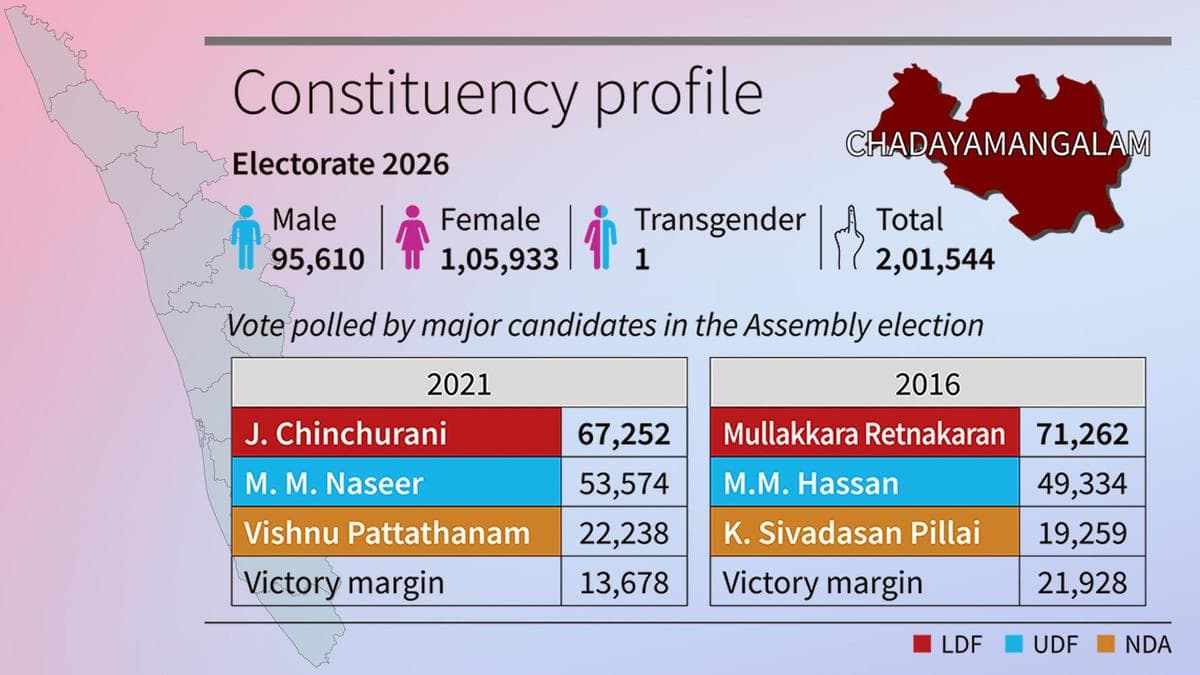
Despite this history of dominance, the 2021 assembly elections revealed a slight shift in the electoral landscape. The CPI's J. Chinchurani won the seat but with a significantly narrowed margin of 13,678 votes against UDF candidate M.M. Naseer. This tightening of the victory gap has sparked renewed hope for the UDF as they prepare for future elections, suggesting that the CPI's stronghold may be gradually weakening.
Simultaneously, the political scene in Chadayamangalam is evolving with the rise of the Bharatiya Janata Party (BJP). Historically, the BJP's presence in the region was minimal, but their vote share saw a notable increase in both the 2016 and 2021 elections. This shift introduces a three-way political dynamic that could reshape the future of this constituency.
As the 2026 assembly elections approach, Chadayamangalam is set to be a significant battleground. The dynamics established by the previous elections suggest that the LDF’s established dominance may be tested more rigorously than ever before. The UDF, buoyed by recent electoral gains, is likely to push for a more aggressive campaign to reclaim its foothold, while the BJP will aim to capitalize on its increasing popularity among voters.
Why It Matters: The outcome in Chadayamangalam could serve as a bellwether for broader political trends in Kerala. An LDF loss could signify a major shift in voter sentiment not just in Chadayamangalam, but throughout the state, potentially altering the political landscape for years to come.
In conclusion, while Chadayamangalam has long been synonymous with Leftist ideology, the impending elections will test whether that identity can withstand the pressures of a changing political environment.
Published - March 19, 2026 07:38 pm IST

Tensions soar as the US and Iran engage in air strikes near the Strait of Hormuz, raising concerns over global oil supply and regional stability.
BBC World
Trump's international interventions face serious stalemates. What will this mean for U.S. foreign policy? Explore the critical challenges ahead.
Indian Express
Tehran denies resignation of President Masoud Pezeshkian amid claims of IRGC influence. What does this mean for Iran's political stability? Click to learn more!
Indian Express