

Image: TechCrunch
Discover how startup Eragon aims to revolutionize enterprise software by eliminating traditional interfaces and leveraging AI for seamless operations.
GlipzoIn the realm of technology, every innovation ushers in a new working paradigm, and the advent of artificial intelligence (AI) is no exception. Josh Sirota, the visionary founder of Eragon, believes that the future of business software could be one where traditional interfaces vanish altogether. Instead of navigating through buttons, dialog boxes, and pull-down menus, Sirota envisions a world where enterprise operations are conducted through intuitive prompts.
Founded in August 2023, Eragon recently secured $12 million in funding, catapulting its valuation to a remarkable $100 million post-money. The startup’s mission is clear: to create an agentic AI operating system tailored for enterprise clients. Sirota succinctly summarizes the philosophy driving Eragon: "Software is dead." This bold statement reflects a transformative approach to how businesses interact with technology.
Eragon aims to consolidate the myriad of business applications—think Salesforce, Snowflake, Tableau, and Jira—into a single interface powered by large language model (LLM) technology. By leveraging AI, Eragon seeks to streamline processes and enhance decision-making for modern teams.
Before launching Eragon, Sirota faced what he describes as a quarter-life crisis, leading him to relocate to San Francisco. He assembled a small, dedicated team in a live-work loft near the iconic Giants’ baseball park. The workspace is a blend of casual and high-tech, featuring a dining table adorned with Moët, several Mac Minis, and a copy of the fantasy novel Eragon by Christopher Paolini—a nod to the company’s name and its inspiration.
Sirota's rich background in corporate software implementation, having worked with giants like Oracle and Salesforce, positioned him favorably in the eyes of investors. His venture has attracted notable backers, including Arielle Zuckerberg at Long Journey Ventures, Soma Capital, and Axiom Partners, among others. Sandhya Venkatachalam from Axiom sees immense potential in Eragon, stating, "We see enormous potential for Eragon to become the connective tissue for how modern teams operate and make decisions."
Eragon is not just a concept; it is rapidly evolving into a comprehensive solution. The technical team includes Rishabh Tiwari, a PhD student from Berkeley, and Vin Agarwal, an MIT PhD graduate. Together, they are diligently constructing the technology stack that will underpin Eragon’s operations.
At their customer center of excellence, humorously represented by a worn-out white sofa, Sirota illustrates how Eragon utilizes its own technology. The company employs open-source models like Qwen and Kimi, which are fine-tuned on customer data to enhance their performance. For instance, when onboarding a new client like Dedalus Labs, Sirota demonstrates how a simple natural language prompt initiates an automatic workflow that creates user credentials and sets up an instance of Eragon in the cloud.
Sirota believes that Eragon could soon be the go-to software for executives seeking insights into potential deal risks or ways to optimize supply chain processes. The AI's capabilities include generating customized dashboards upon request—an impressive feature that showcases the platform’s adaptability.
While the demonstration is captivating, it does raise questions about potential limitations. For example, can the software handle complex queries without faltering? During a live demo, Sirota even highlighted how Eragon can autonomously process invoices that arrive in his inbox, making one wonder about the system's reliability in high-stakes scenarios.
Amidst the excitement of AI advancements lie significant security concerns. Currently, Eragon is focused on fine-tuning its operations in real-world environments, and it has already been adopted by several large enterprises as well as numerous startups. Nico Laqua, CEO of Corgi, an insurance startup that recently raised $180 million post-Y Combinator, has lauded Eragon as “the best applied AI for enterprise in the market.”
Laqua emphasized the importance of data security, stating, “Most of the data we have needs to remain secure and behind our own cloud.” Eragon addresses this by ensuring that customer data remains on their own servers, allowing companies to maintain control over their model weights—the core parameters governing AI behavior. Sirota forecasts that models trained on extensive corporate data will become invaluable assets as companies increasingly recognize their worth.
As Eragon continues to develop and refine its AI-driven platform, the future looks promising. The startup is positioned to reshape the landscape of enterprise software by making it intuitive and accessible through natural language prompts. Industry watchers should keep an eye on Eragon’s growth trajectory, as its innovative approach could set new standards for how businesses leverage technology.
In summary, as enterprises seek more efficient tools for decision-making, Eragon’s unique AI operating system could play a pivotal role in transforming workplace practices, making software interfaces a relic of the past. The coming months will be critical as Eragon expands its user base and refines its technology. Will it live up to the high expectations set by its backers and industry experts? The answer may redefine enterprise software as we know it.
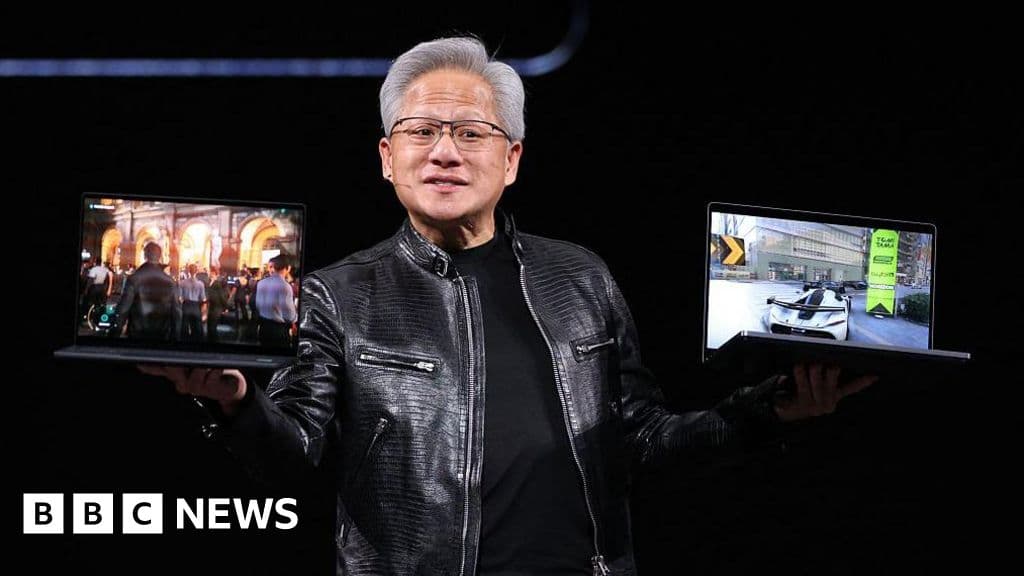
Nvidia's new RTX Spark chip aims to transform personal computing with AI, marking a significant shift in technology. Discover what this means for consumers.
BBC Business
The explosion of Blue Origin's New Glenn rocket raises significant concerns over NASA's lunar ambitions and the future of Amazon's satellite projects. Discover the implications.
BBC Science
Discover how Meta's lack of engagement on user bans raises critical concerns about accountability and transparency in social media governance.
BBC Technology