
Image: BBC World
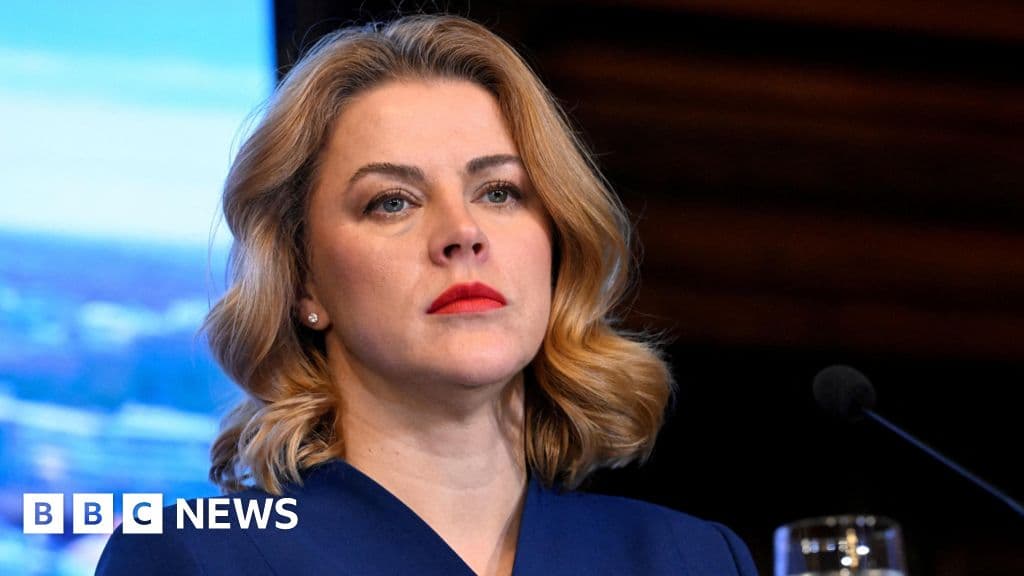
Evika Silina resigns as Latvia's Prime Minister amid a drone crisis, leading to political upheaval just months before elections. What’s next for Latvia?
GlipzoIn a surprising turn of events, Latvian Prime Minister Evika Silina announced her resignation on Thursday, following a heated political crisis stemming from stray Ukrainian drones invading Latvian airspace. This incident has sparked intense debate about national security and governmental accountability, just months ahead of the scheduled general elections in October.
The resignation comes shortly after Silina dismissed Defence Minister Andris Spruds due to his inadequate response to the situation involving three drones that crossed into Latvian airspace on May 7, 2026. The dramatic fallout from this incident has led to the collapse of her governing coalition, as Spruds' party, the Progressives, withdrew their support in protest. Silina's leadership now hangs in the balance as she navigates a political landscape fraught with tension and uncertainty.
The drone incident that ignited this political upheaval involved three UAVs likely originating from Ukraine, aimed at Russian targets but inadvertently drifting into Latvian territory due to signal jamming. Two of these drones crashed in eastern Latvia: one landed on the ground, while another struck an unoccupied oil storage facility near Rezekne. The third drone managed to exit Latvian airspace without causing harm.
Despite the lack of injuries, the local populace criticized the government's response, citing a significant delay in the emergency alert system's activation. Residents expressed concerns that the official reaction to the drone strikes was not only delayed but also insufficient, raising questions about national preparedness in the face of potential threats from neighboring Russia.
Silina publicly acknowledged the gravity of the situation, stating, "Something went wrong. We cannot afford for this situation to continue." This statement underscored her commitment to addressing the shortcomings in Latvia’s defense sector.
Following the dismissal of Spruds, the Progressives party's withdrawal from the coalition led to a swift political crisis, prompting Silina to announce her resignation. In her resignation speech, she remarked, "Seeing a strong candidate for the post of defence minister... political windbags have chosen a crisis. I am resigning but I am not giving up."
This political drama unfolds against a backdrop of increasing anxiety among Baltic nations regarding Russian aggression. Latvia, alongside Lithuania and Estonia, has ramped up its defense spending to 5% of its GDP, reflecting a heightened sense of vulnerability in the region. Silina's government has also implemented compulsory military service in an effort to bolster national defense capabilities.
As President Edgars Rinkevics prepares to make decisions regarding the formation of a new government, the future of Latvia's political landscape remains uncertain. Rinkevics has announced plans to convene on May 15, marking a critical juncture for the nation. The decision will determine whether a new coalition can be established quickly or if Latvia will face prolonged political instability.
The political crisis poses several implications for Latvia, particularly concerning its ongoing support for Ukraine in the conflict against Russia. The outcome of this situation will not only affect national governance but may also influence Latvia's strategic posture in Eastern European affairs. Silina's resignation, paired with the coalition's collapse, raises fundamental questions regarding the effectiveness of Latvia's defense strategies and its readiness to confront potential threats.
With elections looming, the political parties in Latvia will need to address these pressing issues effectively to regain public trust. Citizens are keenly watching how their leaders react to this crisis and what measures will be adopted to ensure national security moving forward.
The resignation of Prime Minister Evika Silina marks a significant moment in Latvian politics, shedding light on the critical intersections of national security, governance, and public trust. As the country navigates the aftermath of the drone crisis, leaders will be challenged to formulate strategies that not only address immediate concerns but also strengthen Latvia's defense and political stability in the long term.
As Latvia prepares for a new government, the political landscape may be reshaped in unexpected ways, emphasizing the need for effective leadership in a time of uncertainty. The coming weeks will be pivotal as the nation seeks to restore confidence and navigate the complexities of a volatile geopolitical environment.

Tensions soar as the US and Iran engage in air strikes near the Strait of Hormuz, raising concerns over global oil supply and regional stability.
BBC World
Trump's international interventions face serious stalemates. What will this mean for U.S. foreign policy? Explore the critical challenges ahead.
Indian Express
Tehran denies resignation of President Masoud Pezeshkian amid claims of IRGC influence. What does this mean for Iran's political stability? Click to learn more!
Indian Express