
Image: BBC World
A Kosovo court sentences Serbs for their role in a deadly September attack, raising questions about Serbia's involvement and future relations.
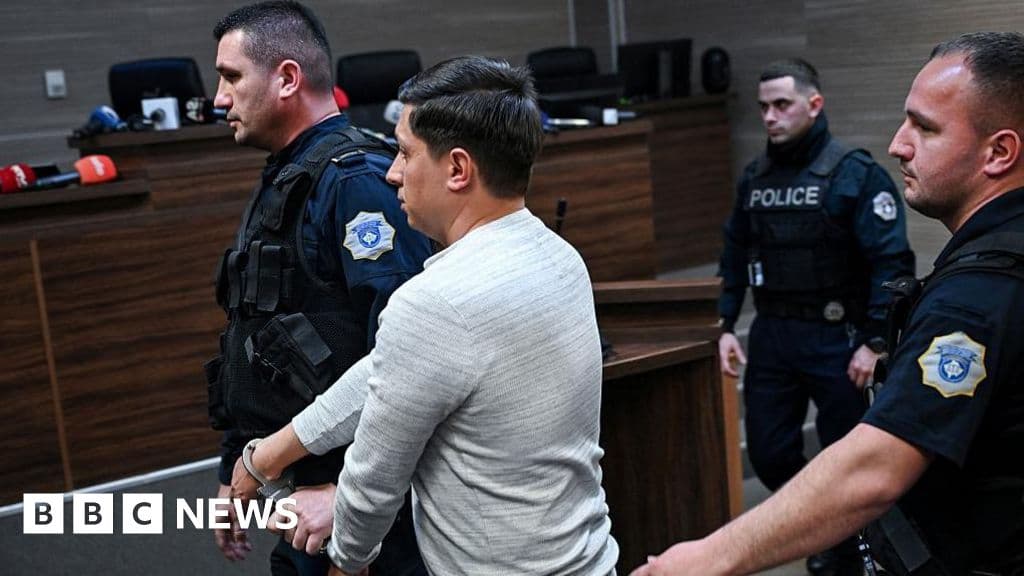
GlipzoIn a significant judicial ruling, a Kosovo court has handed down life sentences to Vladimir Tolić and Blagoj Spasojević, while Dušan Maksimović received a 30-year term for their involvement in a violent incident dubbed the "Banjska incident." This event, which took place in September 2023, involved a fierce gun battle that left a police officer and three members of an armed group dead, marking a critical flashpoint in the already tense relations between Kosovo and Serbia.
The court characterized the actions of the convicted men as a "terrorist attack" that severely violated Kosovo's constitutional order. Prosecutors have implicated a total of 45 individuals in relation to this event, but many of those accused are believed to be residing in Serbia, complicating potential extradition efforts. The sentencing highlights an ongoing struggle for stability in a region still grappling with the ramifications of its 2008 independence from Serbia.
The Banjska incident refers to a day of extreme violence that erupted on September 24, 2023, when police intervened against a blockade set up by a group of approximately 30 armed men. The confrontation escalated quickly, with the armed group launching an attack on law enforcement using firearms and grenades. Tragically, Sgt. Afrim Bunjaku lost his life during the exchange, and several other officers sustained injuries.
The chaos intensified when the attackers retreated to a 14th-century Serbian Orthodox monastery, where they barricaded themselves. This retreat not only heightened tensions but also endangered a group of Serbian pilgrims present at the site. As the hours ticked away, police forces engaged in prolonged gunfire with the armed group, resulting in the deaths of three attackers by the time the situation was brought under control in the late afternoon.
Despite being encircled, the remaining members of the armed group managed to escape, raising serious questions about the effectiveness of the police response and the overall security situation in the region. The aftermath has prompted a closer examination of the links between the Kosovo Serb group and Serbia's government.
The fallout from the Banjska incident has been profound, leading to a reevaluation of Kosovo's security measures and its diplomatic relations with Serbia. Following the court's verdict, Kosovo's acting President, Albulena Haxhiu, emphasized that such attacks on the Kosovo police and the country's constitutional integrity would not go unpunished. She viewed the court's decision as a significant step toward justice.
However, the question of accountability does not end with the recent convictions. Kosovo officials have pointed fingers at Serbia, claiming that the attack had political backing from Belgrade. Milan Radoičić, a politician linked to the armed group and the Serbian List party, openly admitted to organizing the assault but has not faced charges in Serbia. His connections to Serbia's ruling Progressive Party raise suspicions about government complicity.
Prime Minister Albin Kurti of Kosovo has suggested that the attack was part of a broader scheme by Serbia to assert control over northern Kosovo, which has a significant Serb population. This assertion has fueled further tensions between the two nations, which were already strained before the incident.
The sentences handed down by the court are unlikely to foster a sense of reconciliation or improve relations between Kosovo and Serbia. With ongoing dialogue attempts mediated by the EU having stalled, the political landscape remains fraught. Kosovo's Interior Minister, Xhelal Sveçla, has called for Serbia to be held accountable for its alleged role in the violence.
In the coming months, observers will be closely monitoring: - The response from Serbia's government regarding the court's verdict and its implications for bilateral relations. - Whether further legal actions will be taken against individuals like Radoičić, who remain free in Serbia despite serious allegations. - The potential for renewed diplomatic talks between Kosovo and Serbia, especially in light of the EU's involvement.
As both sides navigate these turbulent waters, the long-term stability of the region hinges on addressing these underlying tensions and fostering a dialogue that prioritizes peace and security for all communities involved. The Banjska incident serves as a stark reminder of the fragile state of affairs in the Balkans, where history looms large over contemporary challenges.
The sentencing of the Kosovo Serbs is not just a legal issue; it is emblematic of the deeper political and ethnic tensions that continue to plague the region. As Kosovo strives to solidify its independence and sovereignty, the ramifications of the Banjska incident will likely influence not only local politics but also the broader geopolitical dynamics of the Balkans.
Understanding these complexities is crucial for anyone interested in the future of Kosovo and Serbia, as the potential for conflict or cooperation hangs in the balance.

Tensions soar as the US and Iran engage in air strikes near the Strait of Hormuz, raising concerns over global oil supply and regional stability.
BBC World
Trump's international interventions face serious stalemates. What will this mean for U.S. foreign policy? Explore the critical challenges ahead.
Indian Express
Tehran denies resignation of President Masoud Pezeshkian amid claims of IRGC influence. What does this mean for Iran's political stability? Click to learn more!
Indian Express