
Image: BBC World
Bolivia's Public Works Minister ambushed by protesters while overseeing roadblock clearance. Major unrest highlights deep political divisions in the country.
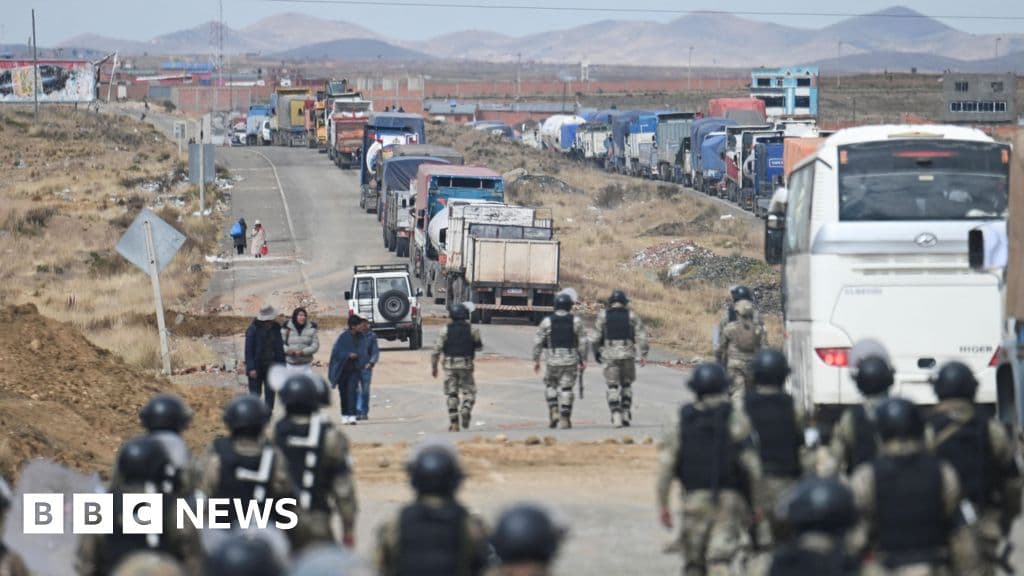
GlipzoOn Saturday afternoon, Bolivia's Public Works Minister Mauricio Zamora found himself in a precarious situation as his convoy was ambushed by protesters in the town of Copata. The minister was overseeing the clearance of roadblocks set up by anti-government activists aimed at disrupting the flow of goods into the capital, La Paz, and nearby El Alto. As tensions flared during this operation, Zamora's vehicle was intercepted, resulting in a brief period where he was unaccounted for.
Local media reported that Zamora's convoy was separated during the chaos but was later located and confirmed to be safe. This incident highlights the significant unrest currently plaguing Bolivia, as demonstrators, primarily supporters of left-wing former President Evo Morales, have ramped up their protests against the government. Zamora's mission was part of a broader strategy to establish so-called "humanitarian corridors" to ensure essential supplies like food and medicine could reach the capital. However, this initiative was met with fierce resistance, including violent confrontations with protesters who reportedly attacked convoys with stones and even dynamite.
The backdrop to these protests is deeply rooted in the political landscape of Bolivia. Demonstrators are exerting pressure on President Rodrigo Paz, who has been in office for just six months. The unrest stems from widespread dissatisfaction with the government's austerity measures, particularly the decision to eliminate long-standing fuel subsidies. This controversial move has led to soaring living costs, prompting many citizens to take to the streets in opposition.
In recent days, the situation has intensified with clashes reported between demonstrators and security forces in La Paz. The protests are organized largely by trade unions and Morales supporters, reflecting a broader movement against Paz’s administration. The protesters' demands are not only focused on economic issues but also reflect a discontent with Paz's perceived alignment with the United States, a contentious point among many Bolivians.
In response to the escalating violence, Bolivia's police and military were deployed early Saturday morning to clear the roadblocks set up by protesters. Their efforts included the use of bulldozers to dismantle barriers made of rocks and concrete pillars, as the government aimed to restore the flow of goods into La Paz. However, these attempts were met with significant resistance, leading to renewed clashes in several areas.
During these confrontations, Zamora's convoy was targeted while navigating through Copata. Eyewitness accounts noted that residents hurled stones and dynamite at the minister’s vehicle, forcing it to take evasive action on a dirt road. Unfortunately, this route led to a second ambush before the convoy was able to regroup.
Meanwhile, protests escalated further elsewhere in the country. In Achicha Arriba, demonstrators looted and set fire to a customs post, and in another incident near Caracollo, a convoy was attacked with explosives, resulting in the burning of a military truck and the looting of a police station. These incidents underscore the chaotic environment surrounding the protests, with reports indicating that journalists covering the unrest were also targeted.
The current unrest in Bolivia cannot be discussed without mentioning Evo Morales, who, despite facing legal challenges and accusations, continues to wield considerable influence among his supporters. Morales has openly backed the protests and criticized President Paz for his government’s austerity measures, suggesting that they disproportionately affect the lower-income population.
Paz's administration has accused Morales of inciting the unrest, framing the protests as an attempt to destabilize the government. In a recent interview with Todo Noticias, President Paz expressed his commitment to dialogue with protesters, asserting that “everything has a limit.” This statement reflects the precarious balance the government is trying to maintain while facing increasing pressure from the streets.
The situation in Bolivia serves as a critical reminder of the fragility of democratic institutions and the complex socio-political landscape in Latin America. The protests, which are driven by economic grievances and deep-seated political divisions, illustrate the challenges facing President Paz's administration as it attempts to navigate a path toward stability. The escalating violence and unrest could have far-reaching implications for Bolivia's political future and its relationship with international partners, particularly the United States.
As the situation unfolds, key developments to watch for include: - Potential negotiations between the government and protest leaders. - The impact of continued unrest on Bolivia's economy and social fabric. - The role of international observers or mediators in de-escalating tensions.
The coming weeks will be crucial for Bolivia as President Paz confronts the challenges posed by widespread discontent and seeks to restore order while addressing the underlying issues that have fueled the protests.

Tensions soar as the US and Iran engage in air strikes near the Strait of Hormuz, raising concerns over global oil supply and regional stability.
BBC World
Trump's international interventions face serious stalemates. What will this mean for U.S. foreign policy? Explore the critical challenges ahead.
Indian Express
Tehran denies resignation of President Masoud Pezeshkian amid claims of IRGC influence. What does this mean for Iran's political stability? Click to learn more!
Indian Express